

Twenty Years of Training and Service
Students gaining experience at the Baylor Psychology Clinic are promoting mental health care throughout Central Texas
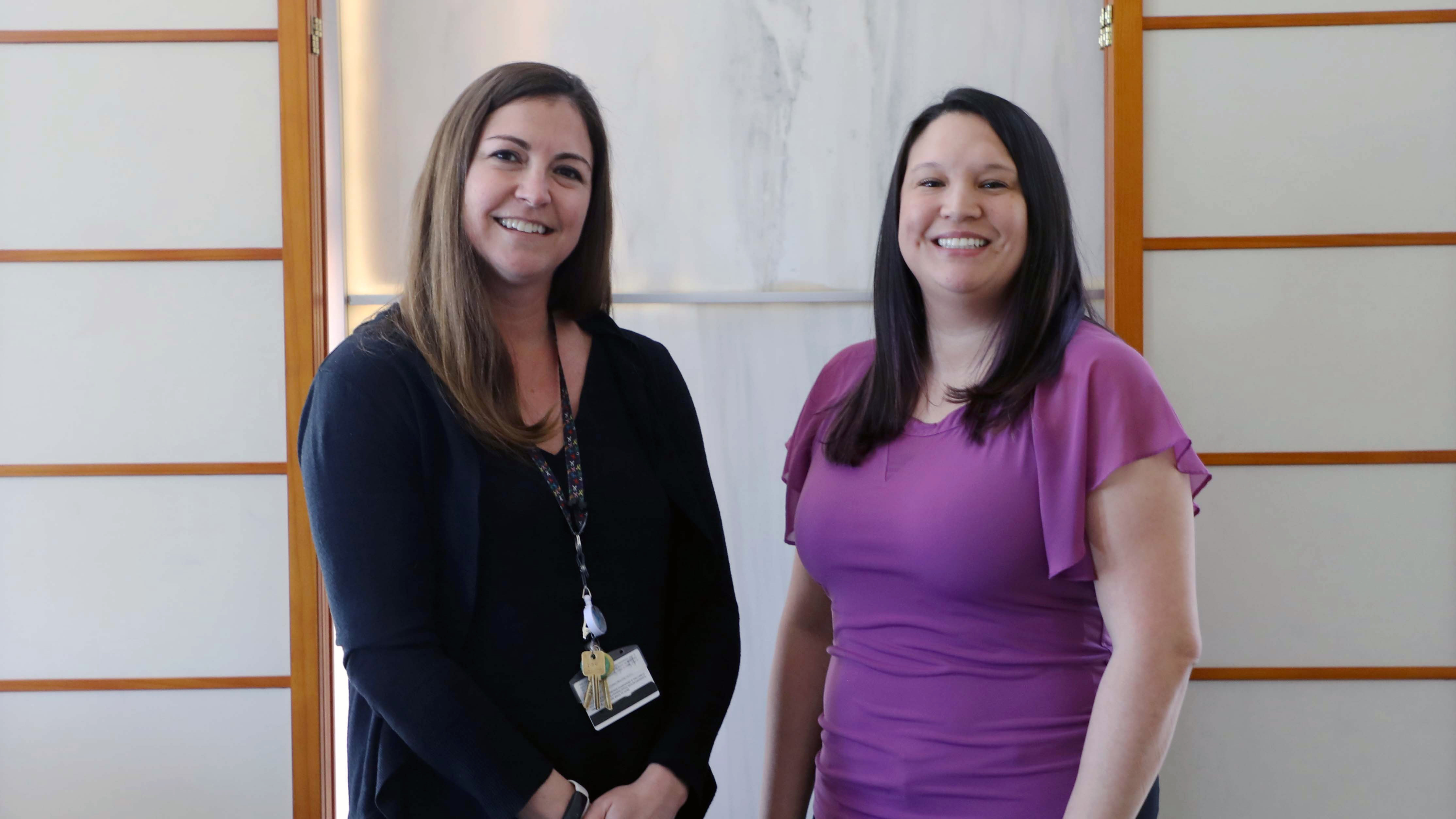
Dr. Alisha Wray (at left) and Dr. Regina Hiraoka provide leadership for the award-winning Baylor Psychology Clinic. (Robert Rogers/Baylor University)
During its two decades of operation, the award-winning Baylor Psychology Clinic has provided important services promoting the psychological health of patients from throughout Central Texas.
Because the mission of clinic –– a training facility under the Department of Psychology & Neuroscience in Baylor’s College of Arts & Sciences –– is to serve not only the Baylor campus but all of Waco and surrounding areas, it’s located at 801 Washington Avenue in downtown Waco so that it’s easily accessible.
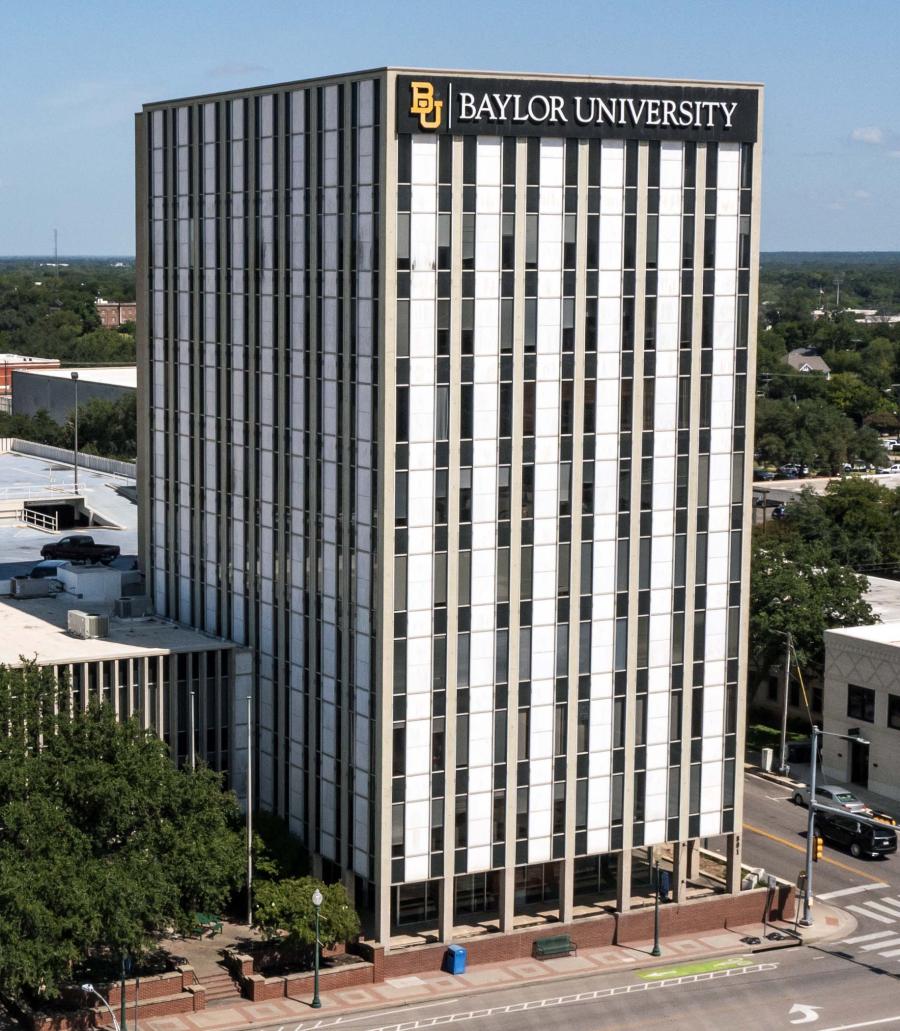
The 4,800-square-foot clinic, which celebrated its 20th anniversary in 2025, is located on the eighth floor of a 10-story building owned by Baylor. A classroom is one floor up, “and a lot of our faculty have lab space in this building on five other floors,” said Alisha Wray, Ph.D., clinical director and clinical associate professor in psychology and neuroscience. Classes for graduate students working toward their doctorate in psychology at Baylor are held in the building as well.
The quality of the Baylor Psychology Clinic (BPC) has been noted by the Association of Psychology Training Clinics, which recently gave the clinic its Innovations Award for a new project they have created which addresses mental health care access in training clinics.
While the BPC does offer its services to Baylor students, “we serve the broader community, and parking here is easier than it is on campus,” Wray said. “Most of our clients find it more convenient to be here.”
Services offered
The BPC provides two main types of services to clients. First, it offers a variety of comprehensive psychological testing and educational assessments that are related to intellectual functioning (such as IQ testing), adult attention-deficit/hyperactivity disorder (ADHD), and other mental health difficulties.
In addition to testing, the BPC offers counseling and therapy services for many common psychological disorders and concerns. Counseling and therapy for these conditions are available for individuals as well as couples and families.
The BPC is staffed by five tenured or tenure-track faculty, three clinical professor faculty, and six community supervisors who participate as adjunct clinic supervisors.
All services of the BPC are provided by doctoral graduate students in Baylor’s Clinical Psychology program under the supervision of licensed clinical psychologists. There are usually about 26 graduate students in the program. Because the clinic is staffed by trainees –– and not licensed professionals –– Wray said some problems might not be suitable for treatment there.
Range of services
Regina Hiraoka, Ph.D., the clinic’s associate director and a clinical assistant professor, said the clinic can provide “assessment services across the lifespan.” Common adult referral questions include attention-deficit/hyperactivity disorder (ADHD), diagnostic clarification of mood and anxiety disorders and disability evaluations. Assessments for children can include referral questions related to autism spectrum, ADHD or learning disorders.
In terms of therapy services through the clinic, treatment is available for children, adolescents and adults. Most supervisors emphasize the use of evidence-based therapy, meaning that clinicians offer treatment approaches that are supported by research.
For example, Hiraoka said one of her main areas of interest involves the treatment of anxiety disorders –– a broad range of things such as panic disorder, phobias, social anxiety, post-traumatic stress disorder (PTSD) and obsessive-compulsive disorder (OCD).
“One of the key things with treatment is helping the client understand the rationale for why you’re recommending what you’re recommending,” she said, “because the treatment approach that has been found to be most effective for anxiety-related sources broadly is called exposure therapy, which is not the same thing as just facing your fears. You have to do it in a really intentional systematic way so that your brain can have new learning, so that it’s not sending out the fight-or-flight response every time that you come in contact with the feared stimulus.”
Student clinicians
Wray said that most students who enter Baylor’s four-year Doctor of Psychology (Psy.D.) program come in with a bachelor’s degree, usually in psychology, and then earn a master’s along the way before graduating with their doctorate. They can then spend a fifth year away from Baylor completing a full-time clinical internship at a site accredited by the American Psychological Association (APA) –– much like future medical doctors might complete a residency program.
During their four years at Baylor, Psy.D. students undertake lab-based research which leads to a “data-driven dissertation,” Wray said, and there’s a requirement to present their research at a national conference. In 2024 alone, she said Baylor student clinicians published 22 articles in professional journals or books.
Face-to-face interaction
Much of the Psy.D. students’ time, however, is spent working face-to-face with members of the public at the BPC.
“All of our students end up seeing clients in our training clinic in some capacity, all four years that they’re in our program,” said Wray, who added that first-year students typically help conduct intakes and screen prospective clients as they learn basic skills, and then eventually begin working one-on-one with clients.
“The complexity of the clients that they see will change over time and the types of cases they can see changes over time,” Wray said. For example, students usually begin with adult assessments, and then later take on child assessments.
“It corresponds with the timing of their coursework and their clinical training,” Wray said.
Hiraoka oversees the supervision of students’ work with clients.
“My main job is working with the students and reviewing video recordings and documentation and meeting with them weekly,” she said. Previous to her role in the BPC, Hiraoka’s job was “100 percent clinical, but through that, I realized how much I enjoyed and valued supervision.”
Student clinicians meet with their clients on a one-on-one basis, Wray said, “because with the nature of psychological services, we don’t do a lot of co-therapy or co-administration of testing measures.”
All of the clinic’s assessment and therapy rooms are equipped with digital cameras so that sessions can be recorded for review. Clients will have signed a consent form acknowledging that they’re aware of the recording.
Reviewing the sessions
After each session, supervisors will meet with the students to discuss what took place, watch video of the sessions and then plan for the next session with the client.
“I really like to balance what could be different or what could be better with what went well, because I don’t want students leaving supervision just with the message of you should not do certain things,” Hiraoka said. “It’s helpful to know what you should continue to do, or what you could do even more so. I like to balance the positive and the negative in an authentic way, not just trying to find something positive, but really facilitating growth as opposed to just saying, ‘don’t do that.’”
When Wray is reviewing students’ work with them, “I ask the student to queue up a portion of the session that they thought was particularly challenging, or maybe a part of the session they thought went particularly well, or something they really just want feedback or guidance on,” she said. “We’ll watch it together so that we can pause and talk about what they noticed in that section or what was going on for them in that moment.”
Supervisors are also able to watch client sessions in real time and are able to intervene if the need arises, but Wray said that rarely happens.
“For example, if there was a high-risk situation that had come up, a client had expressed concerns of or thoughts of hurting themselves or suicidal thoughts, then that might be a time where the student will ask for a supervisor to come in and assist,” she said.
Community impact
About 250 clients visit the BPC in a given year, Wray said. In 2024, for example, “we screened 260 and served 210 of those.”
The Baylor Psychology Clinic partners with other agencies in the area, such as the McLennan County Indigent Healthcare, where the BPC contracts with that agency to provide services at no cost to those clients.
“That’s another example of the service mission of our clinic –– to provide mental health services to agencies or communities in the Waco area that maybe otherwise wouldn’t have access,” Wray said.
Services are provided on a sliding-fee scale, with most clients paying somewhere between $5 and $35 for a visit, which is usually not more than a typical medical visit co-pay. Wray said while the clinic doesn’t accept medical insurance, many clients with insurance still choose to come to the BPC.
“My impression is that we’ve been in the community long enough that we have a reputation for providing cutting-edge, evidence-based services,” she said. “I think these people have had friends or family members who had good experiences with us, or they were talking with one of their service providers who said, ‘I think Baylor Psychology Clinic might be a good fit for this particular need that you’re having.’”
Wray said the clinic also receives referrals from various student-facing offices at Baylor, such as the Office of Access and Learning Accommodation, the campus counseling center and health center, and local agencies such as Waco Family Medicine and Heart of Texas Behavioral Health Network.
Well-trained graduates

Dr. Haley Mayer, who graduated from Baylor’s Psy.D. program in 2024 and worked at the BPC, now serves as a staff psychologist in the Addiction Treatment Center at the American Lake VA Medical Center in Tacoma, Washington.
“The training I received at Baylor prepared me well for my staff position as a psychologist at the VA,” she said. “During my time at Baylor, I was able to develop strong case conceptualization skills and learn evidence-based interventions that I apply daily with veterans. I am especially grateful that I had the opportunity to gain skills consistent with my career goal of specializing in substance use and alcohol use disorders. The Baylor Psy.D. program prepares its students well for independent practice as clinical psychologists.”
ABOUT THE COLLEGE OF ARTS & SCIENCES AT BAYLOR UNIVERSITY
The College of Arts & Sciences is Baylor University’s largest academic division, consisting of 25 academic departments in the sciences, humanities, fine arts and social sciences, as well as 11 academic centers and institutes. The more than 5,000 courses taught in the College span topics from art and theatre to religion, philosophy, sociology and the natural sciences. The College’s undergraduate Unified Core Curriculum, which routinely receives top grades in national assessments, emphasizes a liberal education characterized by critical thinking, communication, civic engagement and Christian commitment. Arts & Sciences faculty conduct research around the world, and research on the undergraduate and graduate level is prevalent throughout all disciplines. Visit the College of Arts & Sciences website.