

The Science of Sleep
Baylor sleep researchers are exploring ways to improve the quality and quantity of the rest we need to thrive
It’s 11 p.m. on a weeknight and three Baylor students are in their rooms, taking an online course on Lithuanian grammar while listening to music. In a little while they’ll turn off the lights and get some sleep before taking an early-morning language exam.
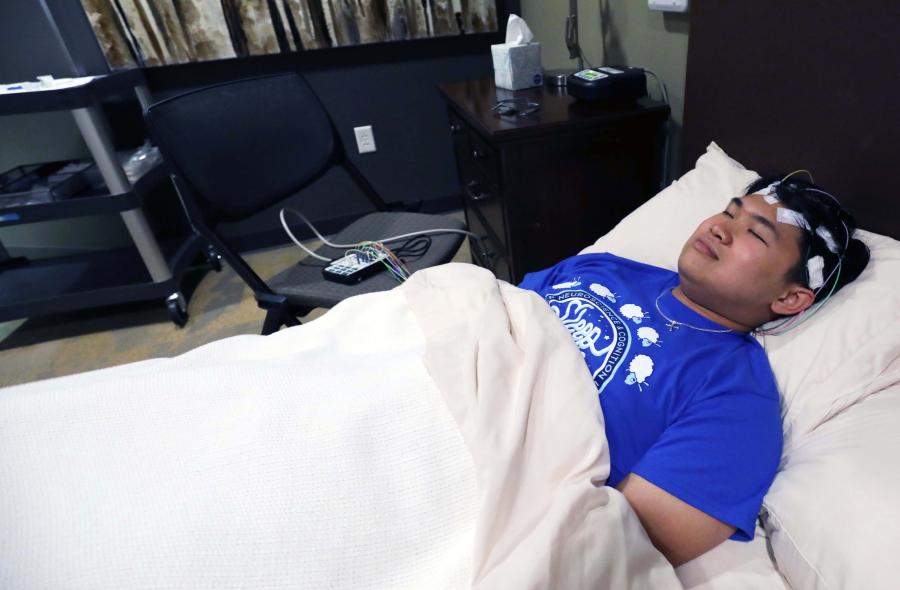
The students are not in a campus residence hall, and Lithuanian is not a language offered by the College of Arts & Sciences. The students are tucked away in bedrooms at a sleep lab where they’re contributing to research that will change the way they and their cohorts study, learn, flourish and succeed.
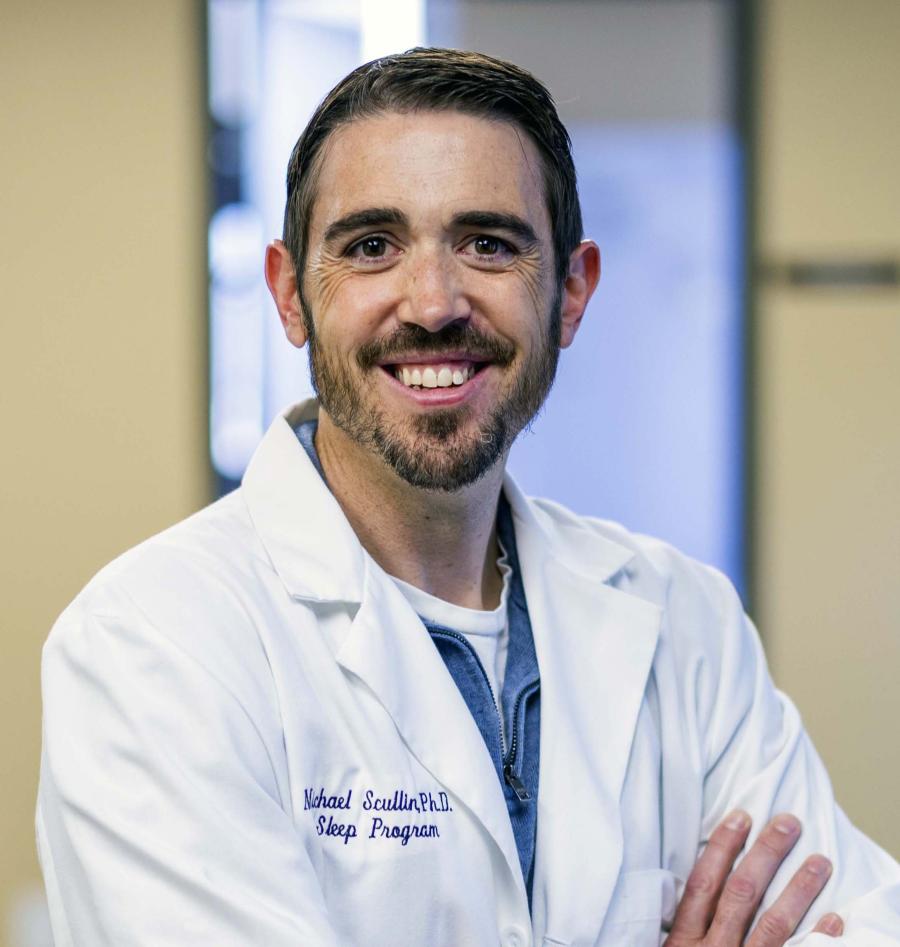
It’s the work of Dr. Michael Scullin, professor of psychology and neuroscience and director of Baylor’s Sleep Neuroscience and Cognition Laboratory.
“A well-rested brain sets a person up for success,” Scullin said. “It certainly sets students up for success because student life is busy and stressful –– both academically and socially.”
And yet, a survey of 1.5 million students conducted by the American College Health Association shows a gradual decline in their sleep since 2000 and a steep decline since 2019.
“Sleep is not improving on college campuses. It’s getting worse on a nationwide basis,” Scullin said. “Sleep health is of growing concern and awareness to leadership at our University and to the College of Arts & Sciences. It’s now part of our five-year strategic plan, which is awesome to see.”
“Sleep is not improving on college campuses. It’s getting worse on a nationwide basis.”
--Dr. Michael Scullin
Scullin knows it’s a problem at Baylor because, while a consensus recommendation for 18-year-olds is to get eight to 10 hours of sleep each night, a survey of Baylor freshmen in their first month indicates more than half get less than seven hours a night on a regular basis.
“That’s actually predictive of their end-of-year grade point average as well as one year later. That tells us sleep does matter to the academic success of Baylor students,” he said.
In addition to sleep impacting memory functioning, it also affects a student’s attention, reasoning and decision-making, as well as regulation of their stress and emotions.
“We’ve done studies where we’ve had people get more sleep than they normally do, and their positive emotions increase –– they show more gratitude and report greater flourishing,” Scullin said. “The point is, if you cut back on sleep, life gets worse, but if you add more sleep, life can get better.”
Collecting data
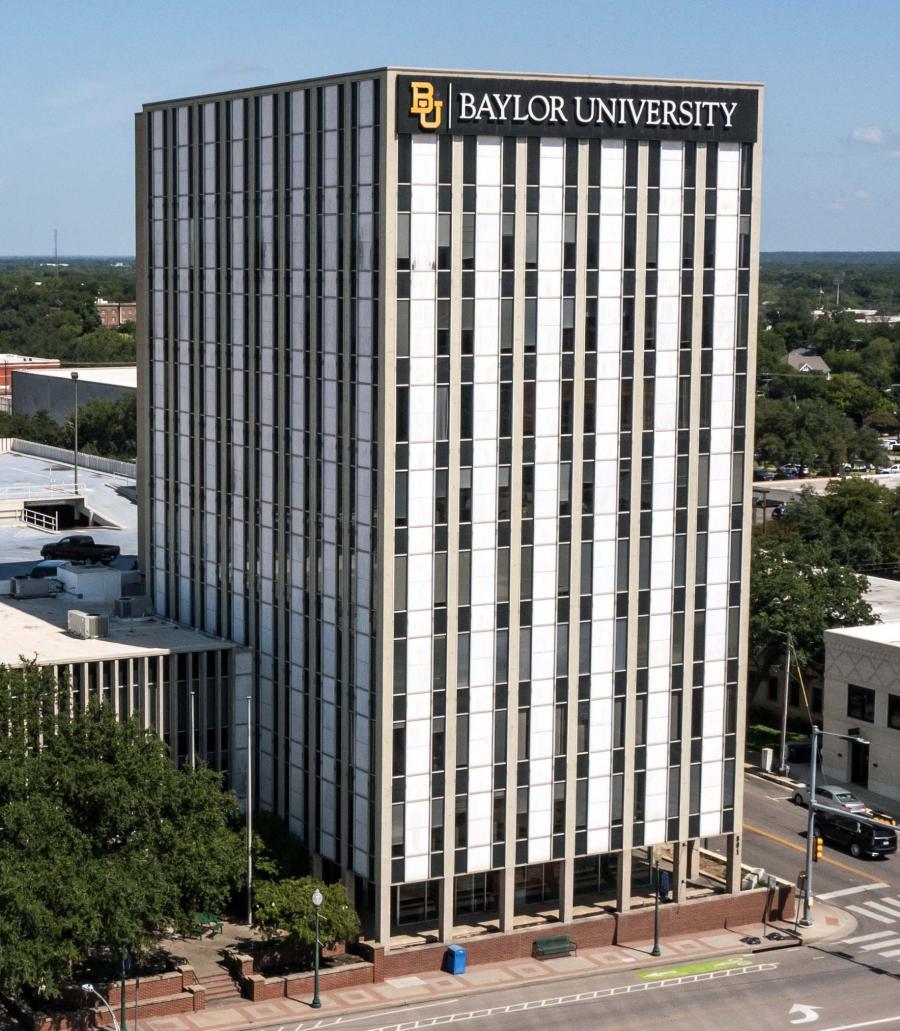
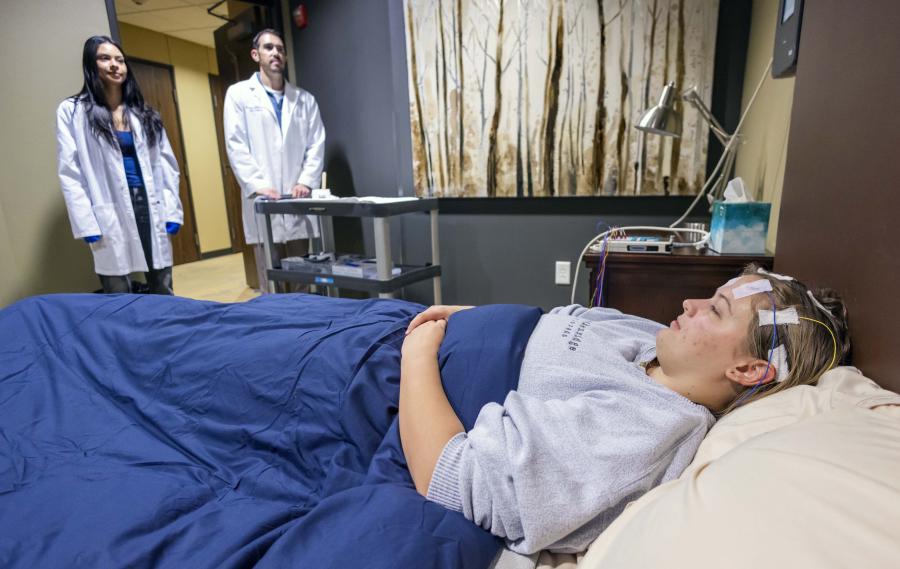
Baylor’s sleep lab is located on the third floor of the University’s high-rise office building on Washington Avenue in downtown Waco. The lab has three windowless, soundproofed bedrooms, and workstations where survey subjects are monitored with polysomnography –– involving a dozen electrodes attached to their heads that record brainwaves while they sleep.
The lab’s staff of approximately 20 includes undergraduate research assistants, graduate researchers and postdoctoral fellows who prepare students for study and sleep sessions, monitor them through the night and score their brain scans. The results become part of the ongoing data collection contributing to development of strategies that improve sleep.
Most sleep studies involve 60 to 100 students who are tested in a variety of conditions. In one study, freshmen took in a virtual lecture on microeconomics while listening to instrumental music. Half were randomly assigned to hear that music again when they reached slow wave sleep –– the deepest stage –– while the other half heard white noise. The next day they were given a microeconomics test, and the students who heard music while in slow wave sleep did 15 percent better.
A current study being done in the Baylor lab compares different types of cramming for exams and the impact that particular study method has on long-term retention. Two different groups are asked to study human physiology for three hours beginning at midnight or 4 a.m., while a third control group studies in the afternoon and gets a full night of sleep. All three groups also spend a half hour studying the Lithuanian language.
“It’s like, ‘Okay, I’ve got this big test on human physiology, but I also have a quiz on Lithuanian the next day,’” Scullin said. “We’re able to compare within an individual and find out –– are they better cramming late at night or early in the morning? Or does it just not matter? Maybe you really just need to set up your schedule so you can get a full night of sleep.”
This study will encompass a year of data collection, while a previous study with students in the lab for seven nights required almost three years of data collection. “That was very difficult work,” Scullin said.
What isn’t difficult is finding students to participate in a study and get paid for their efforts.
“For college students, the idea of, ‘Just sleep over there and get $600,’ generates lots of interest. The line is out the door,” he said.
Scullin said there are other labs around the world interested in sleep and learning, “but our lab is really focused on that translational component of –– how do we try to simulate what a student would be doing at home and what they’d be doing in the classroom? How does that approach inform some of the sleep-memory relationship, and how does it help inform the emergence of new interventions that we can implement for students?”
Creating the sleep lab
Baylor’s sleep lab opened in 2015 when Scullin joined the faculty, bringing with him substantial experience in memory and sleep research. He earned his undergraduate degree in psychology at Furman University where he worked in the lab of Dr. Gil Einstein (a distant relative of Albert Einstein), who was researching “prospective memory” –– the ability to remember to do things in the future.
Scullin worked with one of Einstein’s research collaborators at Washington University while completing his Ph.D. in behavior, brain and cognition, followed by a postdoctoral fellowship in the neurology and sleep medicine program at Emory University School of Medicine. Eager to return to an academic department, he pursued an opportunity to teach and conduct research at Baylor.
“I started teaching sleep and cognition classes, and I was seeing that my students weren’t sleeping. They were taking a class about sleep, but they were not changing any of their sleep behaviors,” he said.
“I started teaching sleep and cognition classes, and I was seeing that my students weren’t sleeping. They were taking a class about sleep, but they were not changing any of their sleep behaviors.”
--Dr. Michael Scullin
Scullin designed a test to explore potential interventions. His students were given actiwatches (like Fitbits) to wear during finals week, and if the watches showed the students slept eight hours a night, they’d get eight extra credit points on their final.
“In that first class, they averaged over eight hours of sleep. It was an entire class, and I was blown away that something could be that successful,” he said.
What’s more, the students did better on their finals than those without the motivation to sleep eight hours a night, and follow-ups several months later indicated they didn’t tend to revert to sacrificing sleep for more study time.
“What we think is happening is, once you start engaging in that healthy behavior, you experience the intrinsic benefits,” Scullin said. “You’re like, ‘I’m not tired all day anymore. It’s nice to feel alert. My well-being is heightened. I feel like I’m flourishing more in life.’”
Scullin has included the challenge in most of his upper-level classes, and especially in his sleep class since then.
Sound sleep for all
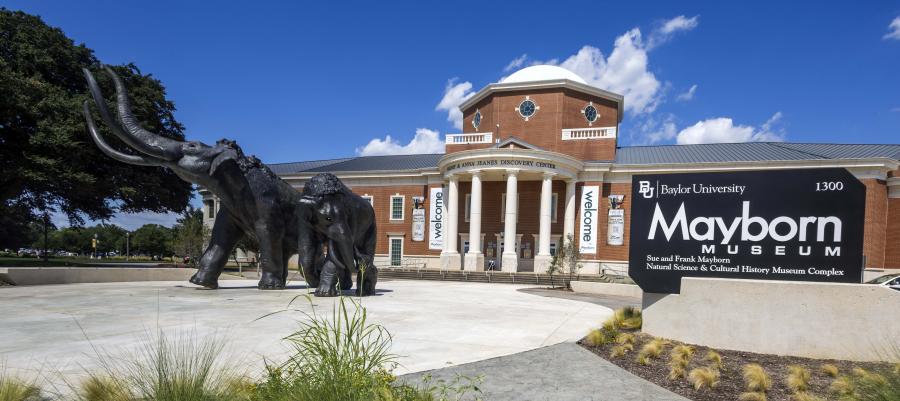
Bringing the benefits of sleep to the public is the motivation for a new exhibit at the Mayborn Museum on the Baylor campus. Located in the second floor Discovery Lab, the exhibit grew out of pop-ups that Scullin’s undergraduate lab trainees and grad students began designing and deploying in 2016.
“I asked them, ‘Okay, what would this look like? We don’t want to just go and talk to people about sleep. We want to have fun activities. The Mayborn has lots of kids, so we want things for kids,’ and my undergraduate trainees were incredibly creative,” he said.
The first pop-up exhibit was a hands-on activity demonstrating polysomnography with electrodes made of buttons, and later magnets on strings, that could be attached to pictures of the brain’s activity centers. Then came an oversized 10-piece brain –– created with a 3D printer in Baylor’s Moody Library Makerspace –– that could be taken apart and explored. There also were stickers and handouts with a brain maze and sleep tips.
“Kids loved to color the brain and do the maze, and if they took it home, it would be a lasting resource with sleep tips on the back,” Scullin said.
Surveys done during the pop-ups indicated that a third of museum visitors stopped to see what was happening (most exhibits get only 12 percent). What’s more, the pop-ups garnered a three-minute average visitor engagement compared to one minute for most exhibits. Anecdotal results also were strong.
“People told us their prioritization of sleep had improved,” Scullin said. “They told us they planned to change their sleep habits, and they told us their perception of scientists had changed, which was really cool.”
With a grant from the National Science Foundation that promotes sharing research in the community, the permanent exhibit at the Mayborn Museum opened in January 2025 with displays created by professional designers.
Museum visitors are greeted at the door by a large cutout of “REM-ee,” a green, C-PAP-wearing “dino-snore-us” who has become the mascot for the sleep lab. Inside, activities and displays describe the stages of sleep, how sleep impacts the brain and body, how small changes in habits can improve sleep and overall health, how the brain cleans itself, and why hunger and sleepiness can feel the same. A video shows brainwaves recorded using polysomnography and what they mean, while a three-dimensional brain lights up showing its different areas and what each one does.
Kids visiting the exhibit can learn how to be “Sleep Super Heroes” and pose for pictures in cutouts wearing caped costumes, while grownups can find out more about snoring and CPAP technology. Also, the adults are encouraged to log on to sleepisgood.com, the lab’s public website containing tips and challenges to improve sleep habits.
“We’re not trying to give any museum visitor a Ph.D. in sleep physiology,” Scullin said. “We’re just trying to give them tidbits they can take home that may be beneficial and maybe raise interest in sleep science.”
April Love, the broader impacts and volunteer engagement manager for the Mayborn, said the collaboration has been great for Scullin’s research as well as for the museum.
“One of the most challenging but most exciting things is this is the first time we’ve really had an opportunity to gather that much data on engagement,” she said. “It revealed so much that we have been taking that model and using it not only for all of our researchers, but for other things in the museum to gauge engagement.”
Love said the Discovery Lab room in the museum was renovated specifically to showcase Baylor research, and there’s room available for other faculty to display their work alongside the sleep exhibit.
“We hope other faculty see what a good partnership and a collaboration with the Mayborn can do and that it’s got all these levels,” she said. “It’s faculty connecting directly with the public in a unique way they can’t anywhere else. It’s professional development for students. It’s service and a connection to Waco’s wider community in a way that increases Baylor’s visibility and reputation.”
Scullin said he’d like to write another grant application to the National Science Foundation’s informal science learning program to create a traveling sleep science exhibition.
“Our goal is to do science that matters to the community around us,” he said. “To the extent we can end up doing work that has a broad influence on a field of science or on communities across the country, great. But you’ve got to begin by thinking locally.”
Dr. Michael Scullin’s Six Tips for a More Restful Sleep
- Avoid electronics at bedtime. Some experts recommend avoiding electronics for up to two hours before going to bed, but this simply isn’t realistic for most people. What we can do is plug in our phones outside of the bedroom — or at least not within reach — and then complete our nighttime routine before turning out the lights and getting into bed.
- Be mindful of what you eat and drink. Better sleep quality is linked to consuming more fiber and less saturated fat and avoiding heavy meals within two to three hours of bedtime. Beverages that contain caffeine and alcohol might not always be perceived as affecting one’s sleep, but laboratory studies show that they affect sleep stage architecture.
- If you snore most nights, make an appointment with a sleep clinic. Habitual snoring is the primary symptom of clinical sleep apnea, which is harmful to the heart, brain and other systems. Most clinics now offer home sleep tests to screen for sleep apnea and there are multiple treatment options now available.
- Spend 20 minutes daily outdoors in natural daylight, especially during the morning hours. The average person spends 90 percent of the day indoors, but people need natural light to synchronize their internal biological clocks. Increase your time outdoors and you are likely to experience greater alertness during the day, and more sleepiness at night.
- Use your bed only for sleep –– rather than for work, studying, or entertainment. Our brains are very good at forming contextual associations, such as a desk always being used for work or a couch always being used for watching television. If we use our bed for both alerting activities and restful activities, then it becomes more difficult to “turn off” our brains at night and fall asleep.
- Write your worries and to-do list before going to bed. Take five minutes to write out everything on your mind before bedtime. This approach offloads stress and gives you a good action plan for the next day. In a prior study, our lab found that this approach helped people fall asleep 37 percent faster.
This article originally appeared in the Fall 2025 issue of Baylor Arts & Sciences magazine.
ABOUT THE COLLEGE OF ARTS & SCIENCES AT BAYLOR UNIVERSITY
The College of Arts & Sciences is Baylor University’s largest academic division, consisting of 25 academic departments in the sciences, humanities, fine arts and social sciences, as well as 11 academic centers and institutes. The more than 5,000 courses taught in the College span topics from art and theatre to religion, philosophy, sociology and the natural sciences. The College’s undergraduate Unified Core Curriculum, which routinely receives top grades in national assessments, emphasizes a liberal education characterized by critical thinking, communication, civic engagement and Christian commitment. Arts & Sciences faculty conduct research around the world, and research on the undergraduate and graduate level is prevalent throughout all disciplines. Visit the College of Arts & Sciences website.