

Bringing Artificial Intelligence into the Baylor Classroom
Baylor Arts & Sciences faculty are successfully integrating AI tools into the curriculum in a variety of ways
Despite their potential for abuse, artificial intelligence (AI) tools can assist with learning in both the classroom and laboratory. We spoke to faculty members in the College of Arts & Sciences to find out just how they are using AI to help their students complete assignments and conduct research.
Journalism and public relations
The Department of Journalism, Public Relations and New Media (JPRNM) has been incorporating elements of AI into the curriculum since the 2023-2024 academic year. Since that time, faculty members have been working on a few ongoing projects involving AI that are showing promise.
Five instructors in the department ––associate professor Dr. Alec Tefertiller, assistant professors Dr. Rosalynn Vasquez and Dr. Elizabeth Bates, lecturer Kim Patterson and a former faculty member now working in industry –– decided to do research and then come up with a project that would introduce AI tools into a classroom and teach students how to use them correctly. Once they created the materials and methods to do that, the faculty members tested them out at Baylor on both an introductory public relations class and a second class that dealt more specifically with AI.
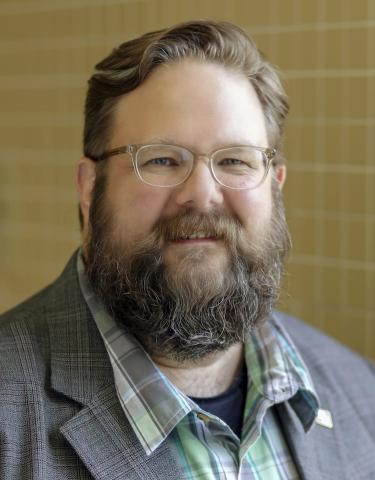
“Students in the PR class used our materials to really learn how to use AI tools, while students in the AI class did some critical thinking of how to apply artificial intelligence to public relations challenges, since they already had the basic knowledge of AI tools,” Tefertiller said. “In both cases, the project showed that this was a great way to introduce artificial intelligence into a PR classroom and give students some practical experience with the tools.”
The faculty members took what they learned and created a teaching brief -- a document designed to give other educators ideas about how to introduce AI into PR classrooms. They presented the brief at the Southwest Education Council’s annual symposium in October 2024, and are now working to get it published so it can be used at other universities.
JPRNM faculty members are also busy creating new AI-related courses that will hopefully debut in the 2025-2026 academic year –– all informed by the lessons captured in the teaching brief. The new courses will center on practical ways for students to use artificial intelligence tools in the work force once they leave Baylor.
"We’re trying to prepare our students to use artificial intelligence in an ethical way."
--Dr. Alec Tefertiller
“We will gear it toward how AI is being used in the industry to help with the work people are doing,” Tefertiller said. “In other words, how can we apply AI in a newsroom? How can we apply AI in advertising or public relations to create content? The Commission on Public Relations Education has said they’re already seeing agencies and professional groups actively using AI in different functions within their work. We’re trying to prepare our students to use artificial intelligence in an ethical way, because that’s going to be expected of them very soon due to all the changes happening in the workplace.”
History
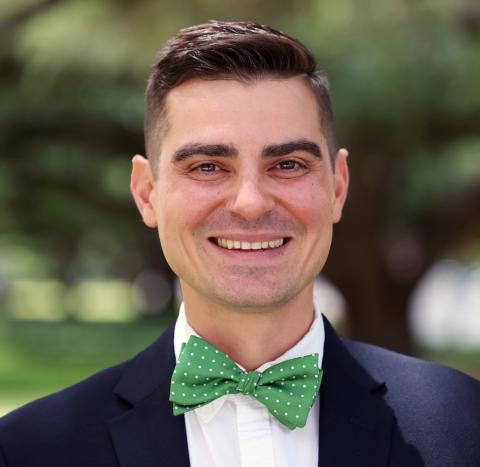
Dr. Daniel Watkins, associate professor of history, teaches courses in French and European history. When he asks his students to write research papers, many of the primary sources they should be investigating online are written in the author’s native language, and have not yet been translated into English.
“That is a real barrier to entry for a lot of students doing research in this field,” Watkins said. “For undergraduate research, we rely on English translations of these documents, but most translations come from human translators, and since they take many years to produce they’re often unavailable.”
Watkins had experimented on his own with AI programs such as ChatGPT to do translations of documents in other languages, and he was “really impressed” with the results. So, in the fall of 2024 he decided to ask his students in a French history class to experiment with the same technology as they researched and wrote their papers.
“The theme of the class was the Napoleonic Empire of the early 19th century, where a lot of the online materials for history research –– such as police records, original manuscripts and handwritten documents –– are in other languages,” he said. “First, I had the students do the traditional way of finding primary sources that I had taught them. Then, the first experiment I did was to ask students who were willing to use ChatGPT as a translator and have it translate some of the foreign language documents to use in their research. I wanted them to discover things such as, would doing this give you access to different types of sources, and would the translations be reliable enough to use?”
Watkins said the experiment went well, for the most part.
“Interestingly, only a few of my students took me up on the offer to use the AI translator. Most stuck to sources that had previously been translated into English,” he said. “In hindsight, I think working more with the tools during class time would have helped drill home that the tools are available and easy to use.”
In the Spring 2025 semester, Watkins is trying the experiment again –– this time in an undergraduate history class on the French Revolution.
“This semester, I’ve done a lot more in class to show students how to use these tools, and I’ve given them time to practice using them,” he said. “So far, the results have been good –– there are still skeptics to an extent, but they have found great sources and been able to explore them in depth, instead of having to rely on already translated excerpts.”
Graphic design
While a number of professionals in the world of graphic design are wary of artificial intelligence tools because of their ability to sample existing artwork and create new designs without crediting the original artists, some graphic designers are choosing to concentrate on the ways that AI can be used ethically to assist them in their craft.

That more hopeful view of AI is shared by Genaro Solis Rivero, assistant professor of art and art history, who teaches courses involving the design of websites, identity design, branding, and packaging, as well as a course in digital imaging graphic design.
“Artificial intelligence tools are helping students and professionals accelerate the design and research process so they can focus their energy and time on more critical tasks,” Solis Rivero said. “Data and facts drive artificial intelligence, so storytelling and curiosity will differentiate the use and outcome of this powerful technology.”
Solis Rivero said that AI simply represents the latest revolution in design –– in much the same way that the introduction of desktop publishing did years ago.
“When desktop publishing came in during the 1980s, many graphic designers said, ‘We’re going to be out of a job.’ But they weren’t –– they just learned to adopt a new tool. And instead of taking one month to lay out probably eight pages, it took them only one day,” he said. “Now with AI, instead of developing a branding system in a month, it’s taking us two or three days or maybe a week. If we use technology in the proper way, it’s just another tool.”
“Artificial intelligence tools are helping students and professionals accelerate the design and research process so they can focus their energy and time on more critical tasks."
--Professor Genaro Solis Rivero
Solis Rivero has been helping his students learn how to responsibly use AI since 2024. He’s shown them ways to use AI to do tasks such as come up with word lists to generate design ideas, as well as clean up or modify visual images. In each case, AI has dramatically cut the time necessary to complete each task.
To help students learn more about how artificial intelligence can be used responsibly in the world of design, Solis Rivero played a major role in hosting a design and AI summit at Baylor in February 2025. Open to students, faculty, staff, alumni and professionals from the Waco community, the summit brought in outside experts in the field to make presentations.
“Our three speakers at the summit emphasized the importance of storytelling,” Solis Rivero said. “The students who attended found it interesting to see the different applications of AI in every industry, not just design. They undoubtedly gained more knowledge about the various AI tools available and the possible consequences of not embracing them.”
Language studies

One of the goals of the Interactive Faculty Advisory Board within the Department of Modern Languages and Cultures (MLC) is to help faculty teaching a variety of languages within the department keep abreast of new technology. That’s why during the summer of 2024, members of the board spent a fair amount of time studying artificial intelligence, and completed AI classes offered by Baylor’s Academy for Teaching and Learning and the University of Chicago.
In addition, using the AI portion of Baylor University’s Recommended Syllabus Statements created by the Office of the Provost as a starting point, the MLC faculty advisory board created an AI statement that is more applicable to courses involving instruction in other languages.
“Baylor’s AI statement is useful, but it just doesn’t quite apply to foreign language teaching and learning,” said Dr. Yuko Prefume, senior lecturer in Japanese.
The MLC statement deals with some of the special challenges AI poses to those learning a new language. Since AI tools can be used as translators, and often performing with a fair degree of accuracy, faculty members must try and make sure that ability is not abused by students.
“Students tend to use Google Translate or other translation programs,” Prefume said. “We really need to communicate with them, especially in the beginning, that AI programs can be used in an assistive way in learning a language, but they should not be used to create finished products for submission.”

Dr. Jill Cornish, senior lecturer in French, uses AI with students in some of her classes, but makes sure from the outset they understand that she doesn’t want them using AI until she’s had the chance to teach them how to do that correctly.
“It’s very important that students, especially in lower-level language classes, get a base before they use more complex resources. At that stage, they don’t know yet how to ask good questions in AI,” Cornish said. “But for our advanced language students, AI is a wonderful tool. They can really use it well because they know how to prompt it and ask for what they need, such as, ‘Give me a practice exercise on the past tense in a certain language.’ For my students, it’s been a real-game-changer as far as saving time in tedious tasks so we can focus on more important aspects, such as the interaction and practicing with the teacher.”
"For our advanced language students, AI is a wonderful tool."
--Dr. Jill Cornish
Cornish said she also uses AI to help produce study aids for her classes.
“When I’ve used AI to generate texts using the grammar and vocabulary we’ve been learning in class so that my students can analyze the texts for grammar and vocabulary, I’ve found it’s excellent,” she said. “It’s a huge time-saver, and the quality of the language in the translation is excellent.”
Prefume also finds that AI helps her to prepare instructional materials for class.
“I can give it a passage in Japanese and have AI create a vocabulary list, or make up quizzes,” she said. “That saves a lot of time for us, and we used to spend a lot of time creating those materials. With the extra time we gain, we can now dedicate more time to individual student guidance, including academic support.”
Film and digital media
Undergraduate students at Baylor are not the only ones using artificial intelligence in their course work and research. In the Department of Film & Digital Media, master’s degree candidate Elle Jansick, who describes herself on her LinkedIn profile as “a storyteller excited by the possibilities of our AI-enhanced future,” is researching ways to use AI to write professional screenplays.
Working with her thesis advisor, Dr. Michael F. Korpi, professor of film and digital media, Jansick is investigating how to use AI to produce a screenplay for a romantic comedy using well-known themes from Shakespearean plays.
“I have a general story mapped out, but like a lot of Shakespeare-based rom-coms, you need to adapt it and bring it into the real world,” she said. “So, instead of making up a story from scratch with the AI, we’re adapting with the AI.”
Jansick will tell AI which Shakespeare tale she wants to base a screenplay on, and after asking for initial observations, she will begin asking a sequence of questions designed to refine each area of the story using any number of variables.
“We’ll see what the AI comes back with, and then we’ll begin tugging back and forth, asking things such as, ‘What if this background character was brought out a little more? Or, what if this Shakespearean fight was turned into a more modern solution? And what would it look like if this location was transformed into another location?,’” she said. “We brainstorm, and once we’ve adapted all of those little pieces, we have a solid foundation for the script with a modern filter put on top of it.”
So far, Jansick has created an early version of a screenplay using assistance from AI that is promising.
“I wrote a script in six hours using AI –– a full, feature-length script 90 minutes long,” she said. “And while it’s not fantastic and isn’t going to win any awards, I definitely would say it’s an entertaining piece of content.”
“Yes, it is entertaining, and it’s funny,” Korpi said. “The dialogue is surprisingly good.”
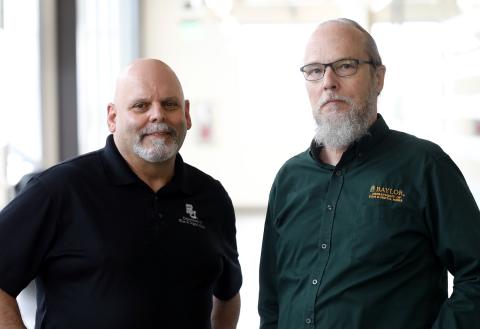
Before Jansick began her graduate studies, Korpi was already doing research into what would be necessary for artificial intelligence to write new textbooks. Both he and his longtime Baylor colleague Dr. Corey Carbonara, professor of film and digital media and Master Teacher, were early adopters of AI technology, and are committed to making sure their students become proficient in the use of AI tools.
“All sort of elements within the production and postproduction process, including visual effects and achieving better color, are already being influenced by AI. It’s a wonderful new support for telling a better story and getting out a more professional product,” Carbonara said. “We need to be embracing this at all levels instead of running away from it.”
"AI provides better output for less money. It’s both efficient and effective."
--Dr. Michael Korpi
Korpi said that mastering AI is already a skill that Baylor students will need out in the job market.
“Employers are going to want people who can do this because AI provides better output for less money,” he said. “It’s both efficient and effective, in the same way that using a calculator is instead of someone insisting they do their own logarithms with a pencil and paper.”
Religion
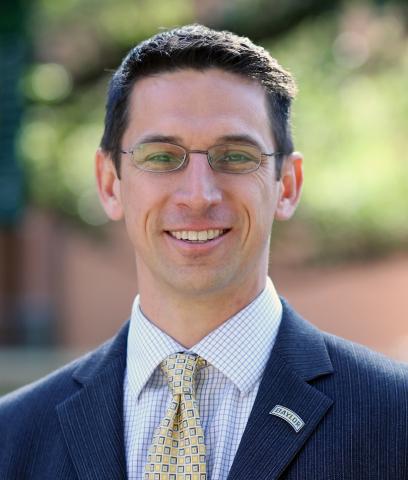
Dr. Christopher M. Rios, associate dean for enrollment management in the Baylor Graduate School, teaches undergraduate courses in the Department of Religion, and has gradually integrated experiments with artificial intelligence into his curriculum. In the Spring 2025 semester, students in his Christian Heritage class are expected to fully integrate AI in their learning.
Rios, who has been asked to join with other Baylor faculty to help the Provost’s Office think about the issues involved with artificial intelligence on campus, believes that educators should help their students meet what he calls “the AI revolution” head-on.
“Regardless of whether our faculty members want to teach with AI or not, their students are going to have to live in a world where AI tools will be ubiquitous."
--Dr. Christopher M. Rios
“Imagine being a student, and you hear from one of your professors that AI is going to handicap your intellectual development, while another one of your professors says that if you don’t use AI, you’re going to be unemployable and hungry. What kind of confused state would that leave you in?,” Rios said. “Regardless of whether our faculty members want to teach with AI or not, their students are going to have to live in a world where AI tools will be ubiquitous. Artificial intelligence will be as much a part of a student’s daily life as the internet is for us. So, the question should be –– how do we help prepare them to thrive in that kind of environment?”
This article originally appeared in the Spring 2025 issue of Baylor Arts & Sciences magazine.
ABOUT THE COLLEGE OF ARTS & SCIENCES AT BAYLOR UNIVERSITY
The College of Arts & Sciences is Baylor University’s largest academic division, consisting of 25 academic departments in the sciences, humanities, fine arts and social sciences, as well as 11 academic centers and institutes. The more than 5,000 courses taught in the College span topics from art and theatre to religion, philosophy, sociology and the natural sciences. The College’s undergraduate Unified Core Curriculum, which routinely receives top grades in national assessments, emphasizes a liberal education characterized by critical thinking, communication, civic engagement and Christian commitment. Arts & Sciences faculty conduct research around the world, and research on the undergraduate and graduate level is prevalent throughout all disciplines. Visit the College of Arts & Sciences website.