

Ever Ancient, Ever New: An English Major for Today’s Baylor Students
Dr. Ginger Hanchey, director of literature and creative writing and senior lecturer in English and Director of the Core in the College of Arts & Sciences, says Baylor’s English department is making the courses it offers better suited to both student interests and today’s fast-changing world
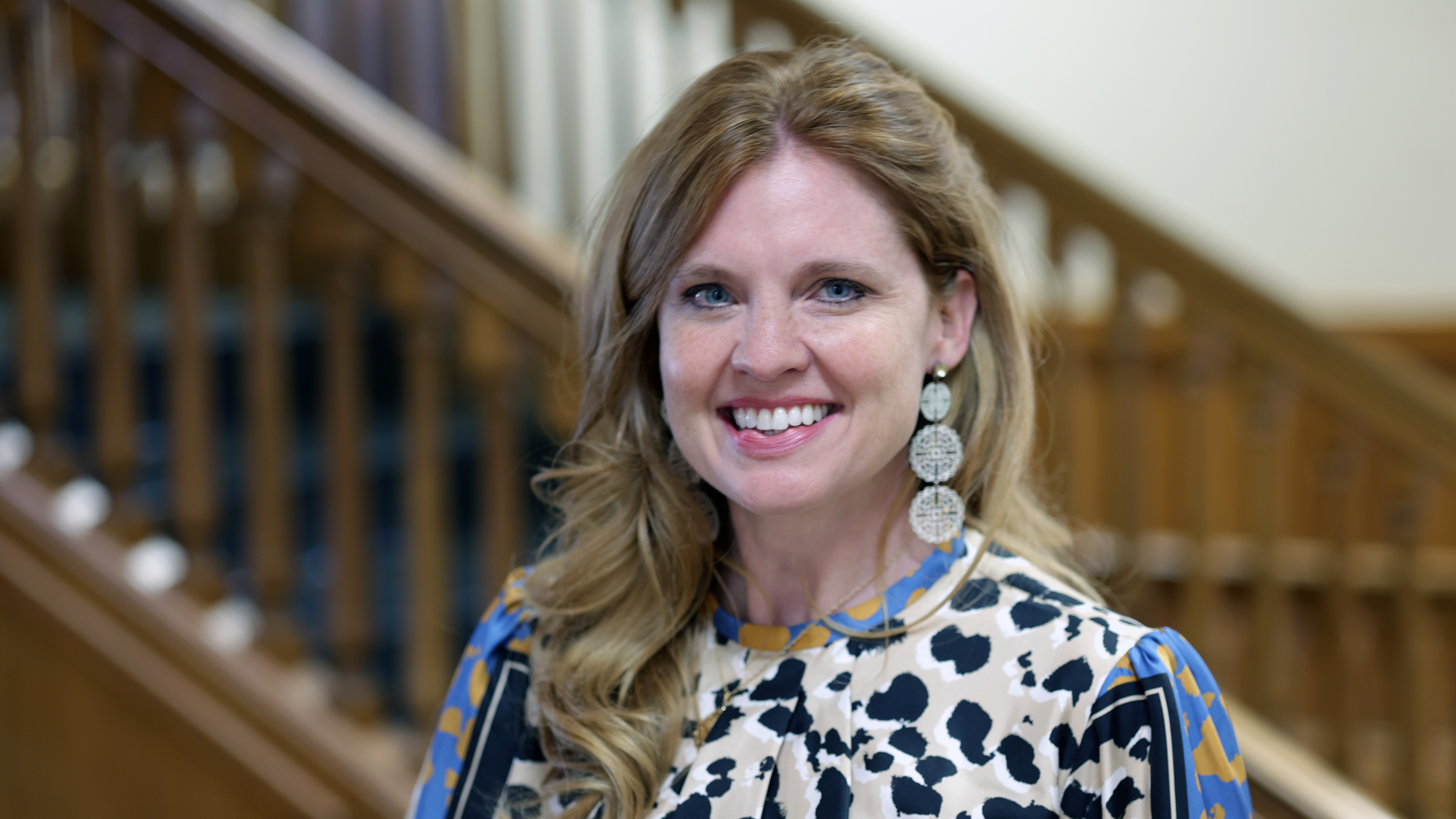
Dr. Ginger Hanchey, director of literature and creative writing and senior lecturer in English and Director of the Core in the College of Arts & Sciences (Robert Rogers/Baylor University)
As the costs and the demand for higher education continue to increase each year across the United States, should degrees in the humanities be made more relevant to modern society and the global workplace? That’s a debate which has been taking place on college campuses for some time now. In this First Person essay, Dr. Ginger Hanchey, director of literature and creative writing and senior lecturer in English and Director of the Core in the College of Arts & Sciences, discusses the continuing efforts being made by Baylor’s Department of English to make the courses it offers suited to both student interests and the demands of today’s fast-changing world.
Since the first Baylor classes began in 1846, English has been a foundational part of the education offered at the University. For decades, the English degree plan has remained largely unchanged.
This year, however, the Baylor English major has undergone a transformation worthy of its bedrock role in the University’s history. Our 31 literature and creative writing faculty have worked hard to make the English major more relevant and life-changing for students, while also making space for non-majors in our upper-level classes. We believe literary art can bring joy and meaning to people’s lives, and we’re excited that these changes will help us be better stewards of this gift.
New offerings
Our faculty members have created almost 40 new courses so far, including:
- Bound, Burned, and Banned: Five Centuries of Banned Books in America
- How We Read: Understanding Narrative Forms
- The Bible as Literature
- Writing Climate Change
- Lit (Taylor’s Version)
- Literary Editing and Publishing
- Shakespeare in our World
- Writing the Young Adult Novel
- Satire
- Discourse with the Divine: Contemporary American Spiritual Poetry
- War Literature
- Magic and Miracles in Medieval Life
- Great Authors: James Baldwin
- Literary Time Travel
- The U.S. Through Immigrant Eyes
- Health and Well-being in American Literature
- Writers of Color and their Allies: 1700-1900
- How Poetry Changes the World
- Novel Adventures
Benefits of change
The English major at Baylor is now one of the most flexible majors on campus. It works great as a stand-alone major or as a second major. It requires only 30 hours of coursework (27 for secondary majors), and six of those hours are in core general education classes that students are likely already taking.
We have also added courses that do not have complicated prerequisites so that students can take them early or late in their college careers.
Our new major respects student choice and interest. While the old major emphasized British and American literature and required three tiers of focus on British and American literature, the new categories emphasize learning to read literature of any kind in its cultural and social context (three classes required here), reading literature written by artists who have been marginalized because of factors like race or gender (one class required here) and learning about literature’s relationship to different career options (one class required here). The degree plan categories are Historical Period (Up to 1700), Historical Period (1700-1900), Historical Period (1900-present), Diverse Perspectives and Career Exploration.
Courses in these degree plans, paired with the general education courses –– American Literary Cultures and either British or World Literature — are the basic English major requirements. Any other hours of coursework required are completely open to students.
Building partnerships
In our efforts to be better stewards of literary art, we are also trying to be better neighbors on campus. We have built partnerships with other academic programs such as Medical Humanities (offering classes that include “Literature, Medicine and Public Health”) and the Christianity and the Arts minor (offering classes such as “The Oxford Christians”). Some of Baylor’s most exciting new interdisciplinary programs — the new Environmental Humanities minor and the new Ethnic Studies minor — have been developed by faculty in our own department. English classes offered in these minors include “Literature and the Environment” and “Asian American Literature.”
And of course, we are ready to support any students interested in continuing their literature studies after graduating. Our faculty have deep connections with the most prestigious Ph.D. and MFA programs in the country. Our field-focused curriculum includes classes such as “Contemporary Critical Theory,” which students can take when they have more hours and more English classes under their belts.
Beyond the classroom
We have developed other out-of-class programming to support students, including a new “Life After College” series, where Baylor English alums come back to talk about career planning and vocation. Helping students see the many careers associated with an English major — and helping them articulate for potential employers what they have learned and what they can do –– has become vitally important to us. We’ve been so lucky to have visits from amazing alums, including John Howard (director of public policy and government affairs for Dell Technologies), Melissa Purdy Mines (a Baylor Regent and the global marketing campaign executive for virtualization and collaboration at NVIDIA) and Jordon Pollard (an attorney and recent editor-in-chief of the William and Mary Bill of Rights Journal).
Jay Fielden, a former editor-in-chief of Esquire, Men’s Vogue and Town and Country Magazine, visited us recently as well, but as an English major alum from “the other BU” –– Boston University –– and as the proud father of a Baylor student.
At all of these “Life After College” events, we eat chips and Queso Mama — “magically cheesy bowls of love.” Queso Mama can be found at retail stores and NFL stadiums across the country, and was developed by another Baylor English major alum, Leigh Smith Vickery. Leigh has also joined us to talk with our students about the importance of storytelling to any business venture.
The Baylor English family wants this next phase of our story to be one of inclusivity and support. If you are a Baylor English alum, please let us know your thoughts. We would love to hear from you and add you to our contact list. You may email us at Ginger_Hanchey@baylor.edu.
*This essay originally appeared in the Fall 2024 issue of Baylor Arts & Sciences magazine.
ABOUT THE COLLEGE OF ARTS & SCIENCES AT BAYLOR UNIVERSITY
The College of Arts & Sciences is Baylor University’s largest academic division, consisting of 25 academic departments in the sciences, humanities, fine arts and social sciences, as well as 11 academic centers and institutes. The more than 5,000 courses taught in the College span topics from art and theatre to religion, philosophy, sociology and the natural sciences. The College’s undergraduate Unified Core Curriculum, which routinely receives top grades in national assessments, emphasizes a liberal education characterized by critical thinking, communication, civic engagement and Christian commitment. Arts & Sciences faculty conduct research around the world, and research on the undergraduate and graduate level is prevalent throughout all disciplines. Visit the College of Arts & Sciences website.