

Learning and Working in Paradise
Baylor faculty and students are doing important scientific research each year in the Galápagos Islands
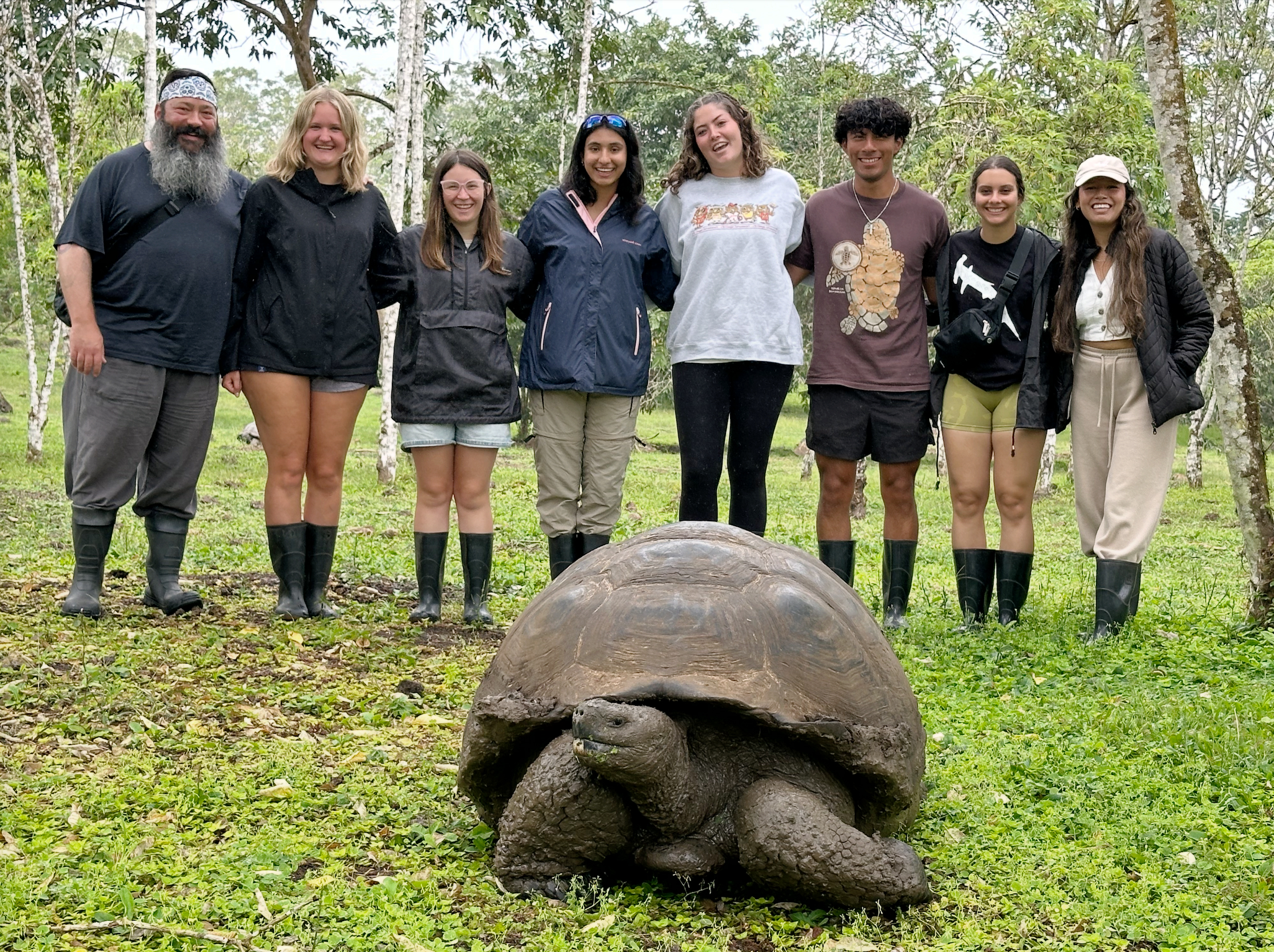
Dr. Michael Muehlenbein (at left) with his students working in the Galápagos Islands in the summer of 2024 (left to right): Charley Beck, Mackenzie Welch, Victoria Gonzalez, Elea Vander Burgh, Brian Hernandez, Amanda Ponce and Diana Moreta
The Galápagos Islands are among the most unusual places on Earth, teeming with wildlife not found anywhere else on the planet and attracting tourists who come to see them. With this island paradise under pressure due to its remote location and popularity, the Baylor University College of Arts & Sciences has two study abroad programs helping point the way forward for the long-term health of the islands’ wildlife, residents and even tourists.
Located on the equator, the Galápagos Islands are an archipelago of volcanic islands in the Pacific Ocean forming the Galápagos Province of Ecuador and the Galápagos National Park. The islands are inhabited by more than 33,000 people, most on the islands of San Cristobal, Santa Cruz and Isabela. The islands’ beauty and unusual wildlife –– giant tortoises, blue-footed boobies, sea lions, marine iguanas, penguins, albatross, Galápagos finches –– are famous in science history for their contribution in the 1830s to Charles Darwin’s theory of evolution by natural selection.
Protecting tourists, residents and wildlife
Since 2023, Dr. Michael Muehlenbein, professor of anthropology, has taken Baylor students to the Galápagos Islands each summer, where they spend a month surveying tourists about travel health and interactions with wildlife, and island residents about public health issues.
The tourist surveys continue a research project Muehlenbein began in 2006 in Malaysian Borneo, followed by research done in the West Indies island of Saint Kitts as well as in Japan, South Africa, Gibraltar, Thailand and now the Galápagos Islands. The surveys cover perceptions of risk of emerging infectious diseases –– what people truly know versus what they think they know, and how that impacts their behavior and willingness to take risks that may lead to the transmission of infection between species.
“A lot of human-wildlife overlap characterizes all of these places, and one of the things we’ve found after 10,000 interviews is that people who care the most about wildlife are actually those who are most willing to take risks such as physical contact, even though they understand the potential consequences for both the wildlife and themselves,” Muehlenbein said.
In the Galápagos Islands, the research has expanded to surveys of island residents, which has become the largest part of the project and is popular with the residents.
“That’s because these people are not usually given a voice,” Muehlenbein said. “Accessibility to health care is limited to only a few clinics, and what they would call hospitals are actually understaffed and unequipped.”
Into this environment, Muehlenbein brings up to eight Baylor undergraduates for a month each summer. Most have their sights on medical school, veterinary school or a career in public health, and their research on the islands relates to the principles of One Health, which are applicable in all those specialties.
“One Health is the idea that to understand an infectious disease problem, we need to understand the human and non-human animal components and the environments in which these things happen, because everything is connected,” Muehlenbein said.
Before leaving for the islands, students learn about One Health, global health and conservation medicine, which is the application of One Health to protecting endangered species. They also learn the ethics of working with human subjects and the nuances of survey design.
The students’ time on the islands is split between data collection at sites of tourist and resident concentration, and local experiences such as visiting hospitals, clinics and wildlife sanctuaries. They see first-hand the impact of issues such as healthy food and fresh-water insecurity, poor sewage infrastructure and limited health care resources.
“Ultimately, we want to protect the wildlife that people are coming to visit and the locals helping maintain the wildlife, and one reason I think we’re so effective at this is the Baylor undergrads I’m bringing,” Muehlenbein said. “They are some of the most amazing students I’ve ever had. They are mature and compassionate, and they’re not going just because Galápagos is on their bucket list.”
To provide these dedicated students the best possible experience, Muehlenbein limits their number to eight, checks out every location and activity personally, and rents lodging occupied only by the Baylor cohort. The program is also what he calls “family-based.”
“We have all our activities together. We share every meal together. There’s no going off on the weekend and saying, ‘I’ll see you next week,’” he said. “It’s like I’m a faculty in residence. I’m their teacher, I’m their research advisor, but I’m also a dad or uncle, however they want to view it. And I take that role very seriously.”
International partners
Muehlenbein credits much of the program’s success to Universidad San Francisco de Quito (USFQ), one of the largest and most prestigious schools in Ecuador and the only institution with a small campus on the Galápagos Islands. Muehlenbein visited the university before and after the COVID pandemic to build the relationship that is vital to the program.
“They provide not just every bit of detail up front, but their on-the-ground support in real time is fantastic,” he said. “We’re never alone –– we always have a representative from the university with us.”
While USFQ partners with other universities and hosts international students for their own programs, Baylor’s relationship is different, Muehlenbein said.
“There’s no other partner at USFQ engaging undergrads in research like this,” he said. “I’ve been told multiple times it’s a unique model for research data collection driven by undergrads.”
Muehlenbein said USFQ is building a satellite campus on the main island of Santa Cruz, “and they’re very enthusiastic about Baylor becoming a more permanent part of that for both student and faculty research exchange.”
Putting data to work
In the summer of 2026, the Baylor cohort, at the request of the Ecuadorian government, will update educational signage around two of the islands that have the most tourism-wildlife contact. They’ll also map all the public and private health clinics on three of the islands.
“We can do things like beach cleanup that really is aimed at making ourselves feel better, but this time we’re going to be physically making and replacing the signage around some of the most popular tourism areas,” Muehlenbein said.
The signage will help tourists who may need health care, but will also highlight to the local government how underserved the local population is medically.
“We can tell them how much people need things until we’re blue in the face, but we need data to show them how frequently people have to go off the island for health care,” he said. “The other thing we’re doing is a series of TikTok educational videos to better prepare people before arrival in the islands.”
Back home in Waco, an exhibit titled “One Health: Galápagos,” opened in December 2025 at the Mayborn Museum with representatives from USFQ present for the festivities. Highlighting the work the Baylor program has done in the islands, the exhibit features text and photography contributed by Baylor students. They also built what Muehlenbein described as a “ginormous trash monster” –– in the shape of a sea turtle five feet by four feet by three feet –– that is part of the exhibit.
Learning on many levels
Charley Beck, a University Scholars major from Kansas City, Missouri, applied for the program in 2024 when she learned it aligned with her interest in global health.
“And who doesn’t want to go spend a month in the Galápagos Islands?” she said.
Going there as a researcher and not a tourist, Beck learned much from the experience. The research involved approaching tourists and local residents at locations of high concentration and asking them to complete a 15-minute survey on a digital tablet.
“Just going up and talking to random strangers is not really one of my strong suits. It definitely put me out of my comfort zone, but as I did it more and more, it became easier,” she said.
While Spanish was not a requirement for the Galápagos program, Beck said knowing at least some Spanish was helpful in a setting where the locals and a majority of tourists from South America speak Spanish.
“We had a script of what to say –– how to initiate the conversation and the questions to ask because we had to make sure we were informing them about the survey and everything they would be doing for the research,” she said.
Beck said the students didn’t design the initial questions, but they helped finalize the survey, make sure everything was completed, and they collected the data. Beck has been involved with processing the data for more than a year now. She’s presented some of that data at Baylor’s Undergraduate Research and Scholarly Achievement program, and her thesis is based on the data.
“I’ve learned through, not just being in the Galápagos, but being involved in research from hypothesis to results, which has been a really interesting experience,” she said.
When not conducting research, the cohort enjoyed the excursions planned by Muehlenbein.
“It’s really fun to be in a tight-knit group where you’re doing everything together. I’ve made some really good friends from the experience,” Beck said.
As she now applies for medical school, Beck said the program has provided her with a valuable global perspective on public health.
“It was really an eye-opening experience, and not just conducting the research, but being in that environment,” she said.

Understanding freshwater ecosystems
Fresh water in the Galápagos Islands is limited due to the islands’ volcanic history and shortage of permanent surface water storage areas, but a second Baylor Arts & Sciences study abroad program is gathering data there for potential solutions.
“We’re trying to understand how freshwater ecosystems function in Galápagos,” said Dr. Cole Matson, associate professor and graduate program director in the Department of Environmental Science. “Galápagos is an interesting area from a water chemistry perspective in that these are relatively young volcanic islands and the volcanic substrates are high in phosphorus, which is generally a limiting nutrient in freshwater systems. The naturally high levels of phosphorus heavily influence nutrient cycling and ecosystem metabolism.”
A program to gather data on these systems began four years ago after Matson met with researchers at Escuela Superior Politécnica del Litoral (ESPOL), a university in Ecuador’s largest city of Guayaquil, and with staff at the Galápagos National Park to set goals and parameters for the research.
“This is a study abroad program, but from the national park’s perspective, they don’t allow people to do what we do purely for educational purposes. They are looking for information that can help them manage their resources more effectively,” Matson said.
Because much of the research involves gathering water data at non-tourist sites, the national park limits the Baylor contingent to six students. Applicants are not limited by major, but most have been biology or environmental science majors.
“Some of the students have already had my Field Techniques for Environmental Science course where they get trained to do a lot of the same types of research and monitoring with the equipment we use, but most of the training for the program actually happens in Galápagos,” Matson said.
The research involves testing water over three-and-a-half weeks at locations on the three largest islands.
“With Santa Cruz and San Cristobal, upland freshwater sites are our main focus,” he said. “Isabella doesn’t really have upland freshwater sites, so there we’re working more on brackish water coastal lagoons.”
Matson said the Galápagos study abroad program is different from a lot of others in that it’s research-focused rather than course-based, but in some ways the experience is like being in a classroom.
“There’s a huge amount of discussion of ecology, evolution, ecosystem function and aquatics. All of these things are part of the everyday conversations we’re having,” he said.
On days when they’re not in the field, the Baylor students get to snorkel, hike and visit other interesting sites, often led by national park guides. And whether the students are working or touring, there is plenty of wildlife to see.
“What I tell prospective students when I talk about Galápagos is it’s not the diversity that’s so amazing –– it’s the fact that you get to experience it so close because the animals are not afraid of you,” Matson said. “You don’t need binoculars to see the wildlife. They’re right next to you, and you’re stepping around them.”
Matson said he had wanted to visit the Galápagos Islands since he was a child, and when the opportunity came to start this program, it fulfilled that desire and much more.
“For one, to do important research in Galápagos, to help Galápagos manage their resources and provide whatever assistance we can to help them make management decisions,” he said, “but also to provide a unique and powerful experience for students to do research in one of the most amazing ecosystems on the planet.”
Shaping her future
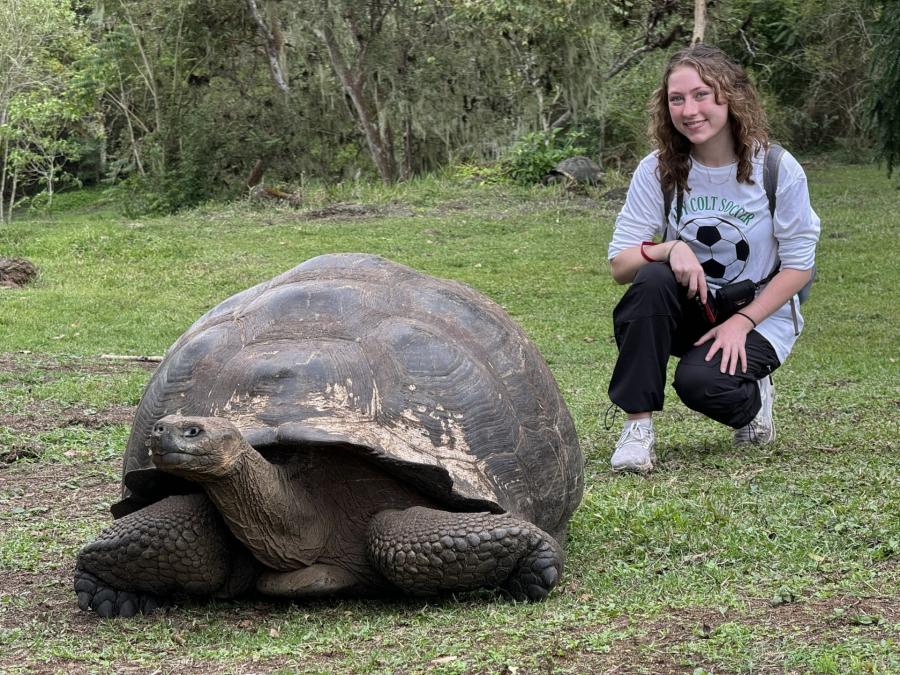
Kendall Greer, a graduate student working on her doctorate in environmental science, has been to the Galápagos Islands twice –– as an undergraduate in 2024 and in 2025 as a teaching assistant. She heard about Baylor’s program at a study abroad fair and learned it was a research opportunity with course credit.
“I was interested in large-scale ecology, and I was also interested in small-scale genetics, so I went on this research opportunity to narrow down what I wanted to do for research,” she said. “When meeting Dr. Matson and talking about my interests, he said, ‘My research actually deals with everything. You wouldn’t need to narrow down what you’re doing.’”

Greer said the research on Galápagos is performed with EXO Sonde platforms made by YSI. The monitoring devices are left in the water for several days and gather data such as levels of dissolved oxygen, pH, salinity and conductivity. The devices are then retrieved and the data is uploaded to computers for graphing and analysis.
“Because the water resources in Galápagos, both freshwater and saline, aren’t very deeply studied, we’re trying to get baseline data about those water bodies,” Greer said.
While on the islands, Matson’s students stay at hostels he has arranged for them. Transportation is provided by taxis –– trucks, actually –– that usually move tourists and their baggage around but help the Baylor cohort get to research sites with their testing equipment.
Greer said Matson makes sure the students have at least one excursion on each island such as snorkeling, hiking or exploring different parts of the island. The students can go anywhere they wish for meals, but they usually stay together.
“It’s a small group and we’re the only people we know on the islands,” she said. “You get to know these people well. It’s definitely a unique experience you share with very few people.”
Greer said the biggest challenge during their time on the islands is being patient and understanding that not everything happens on Baylor’s time. The “coolest” part of the experience is the wildlife.
“I took an evolution class before I went, so knowing the evolutionary history of these animals and being able to see them and be two meters away from them is just incredible,” she said.
More research is planned, and Greer hopes to be part of that.
“We’re only on each island for one week, so it’s very narrow data sets,” she said. “We have future plans to leave the devices there and get research throughout the year, which will allow us to learn more about how these water bodies function and how the environment is changing through time.”
Greer, who now works as an assistant in Matson’s lab, said the Galápagos trips have helped direct her career path and what she wants to do as a researcher.
“What I’m researching now isn’t exactly what I did in the Galápagos,” she said. “However, I learned the research skills and how to plan an experiment and find the steps to get to where you need to go.”
ABOUT THE COLLEGE OF ARTS & SCIENCES AT BAYLOR UNIVERSITY
The College of Arts & Sciences is Baylor University’s largest academic division, consisting of 25 academic departments in the sciences, humanities, fine arts and social sciences, as well as 11 academic centers and institutes. The more than 5,000 courses taught in the College span topics from art and theatre to religion, philosophy, sociology and the natural sciences. The College’s undergraduate Unified Core Curriculum, which routinely receives top grades in national assessments, emphasizes a liberal education characterized by critical thinking, communication, civic engagement and Christian commitment. Arts & Sciences faculty conduct research around the world, and research on the undergraduate and graduate level is prevalent throughout all disciplines. Visit the College of Arts & Sciences website.