

Discerning Right and Wrong
Baylor students are learning strategies to help them look at life through an ethical lens
One of the goals of Baylor’s College of Arts & Sciences is not only to provide its students with the skills and information needed to make a living –– but to share wisdom about how to live a purposeful life guided by a system of values. Such a practice helps Baylor University fulfill its mission to “educate men and women for worldwide leadership and service.”
One of the ways that Baylor shares the University’s values with students is through encouraging them to look at the part they will play in the world in an ethical way. And for some students in Arts & Sciences, that appreciation of ethics has led them to discuss and defend issues of right and wrong with their counterparts from colleges and universities across the United States.
Going bowling
A large number of students with majors in the College of Arts & Sciences are seeking careers in healthcare, which gives them a special interest in grappling with issues of bioethics. Starting in 2023, Baylor students have competed in the National Bioethics Bowl, an intercollegiate academic competition in which students from U.S. colleges and universities debate a wide variety of bioethics topics.
In April 2024, Baylor University hosted the national bowl on its campus, welcoming 20 teams from schools such as Harvard, Stanford, the University of Pennsylvania and the University of California Berkeley.
A year later in April 2025, Baylor students competed in the National Bioethics Bowl held at Westminster University in Salt Lake City and placed eighth out of 19 teams.
“The team had a great time competing at Westminster,” said team coach Daniel Crouch, a doctoral candidate in religion. “Although it was a completely fresh team, being everyone’s first year to compete, we had an excellent performance and ended up placing eighth, with two wins and one loss. Everyone on the team is excited to compete again next year.”

There is another type of ethics competition that is not limited to issues of bioethics. In November 2024, Baylor entered a team of students in the regional Association for Practical and Professional Ethics Intercollegiate Ethics Bowl for the first time. The online contest featured three preliminary rounds in which teams debate ethical scenarios in various topics. The Baylor squad faced Georgia Southern, Georgia State and Grossmont in those rounds, and then advanced to the semifinal round, where it lost to eventual regional champion University of North Carolina.
Baylor’s performance, however, was strong enough to earn a qualifying bid to the national Ethics Bowl competition, which was held in February 2025 in Norfolk, Virginia. The team placed 22nd out of 36 competitors.
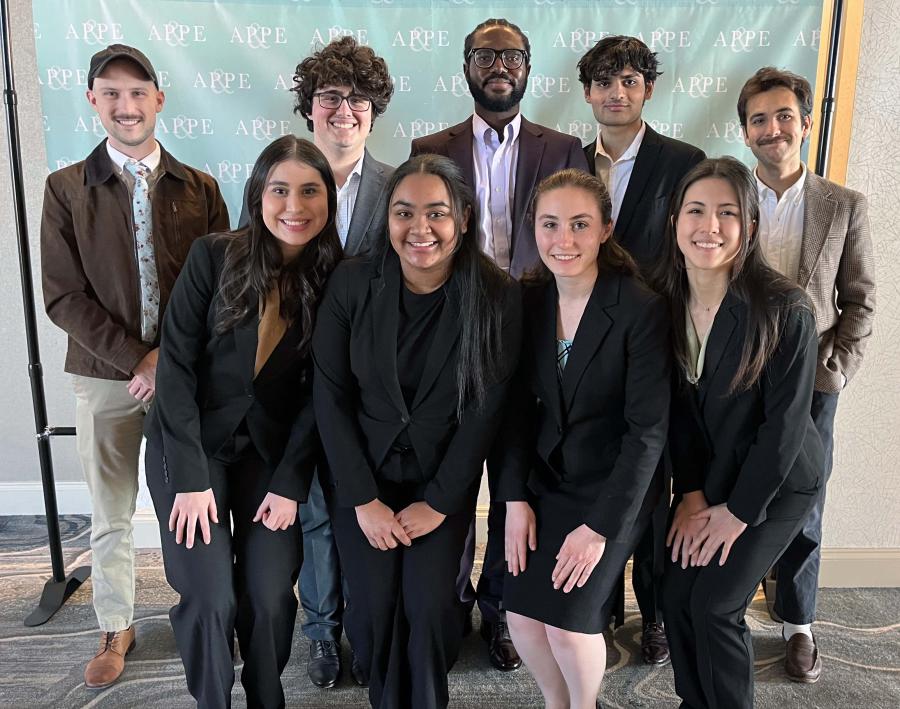
The captain of both the ethics and bioethics teams for Baylor this year was Shajee Khan, a freshman from Las Vegas, Nevada.
“It was a lot of work because, obviously, it was my first year at Baylor, just as a college student,” Khan said, “and then with both the Ethics Bowl and the Bioethics Bowl, which essentially started in early October and went to April. Every single week we met.”
Khan wasn’t the only newcomer on the two ethics teams. The most recent bioethics bowl team was made up of students who were taking part in the competition for the first time, and five of Baylor’s inaugural Ethics Bowl squad of seven students were freshmen.
“The freshmen did a great job, especially in an activity that requires public speaking and doing ethical analysis in ways I think most of them don’t do much in their own majors,” said Nick Hadsell, who served as the coach of the Ethics Bowl team in the national competition while finishing up his Ph.D. in philosophy at Baylor. “Shajee was basically doing the work of a coach and just knocked it out of the park. He was a fantastic leader.”
Thoughtful preparation
Before each of their ethics competitions, Baylor’s teams receive a slate of cases well in advance of the contest date. The teams divide up the cases and “prepare presentations on the salient issues in each case, and a position that we should take on it to defend in the rounds,” said Hadsell, whose academic specialization was in ethics and political philosophy.
During weekly meetings prior to competition, Hadsell “would go over different ethical theories with them that they might apply to different cases,” he said. He would then take on the role of a contest judge and offer tips on how to “sharpen up the arguments” of the students.
Khan said the team members would deliver presentations on two or three cases at each meeting, “then we would give each other feedback, and it was very much a learning process because none of us had competed in it before.”
In the Ethics Bowl, case topics can include “business ethics, healthcare ethics, medical ethics, animal ethics, and anything and everything in between,” Khan said. The Bioethics Bowl, meanwhile, concentrates on ethical issues in fields such as medicine, biotechnology and healthcare.
Grappling in the arena
Just how are ethical issues debated in one of these national bowls? During the competition, team members from two opposing schools, as well as a moderator and judges, gather in a room –– or, in the case of the regional Ethics Bowl competition, will meet over Zoom –– and one team is assigned a case drawn from the ones they had been preparing. The moderator then asks a question about that case, and the team has 10 minutes to discuss “ethical dimensions of the case related to that question,” Khan said. The opposing team is then given a five-minute rebuttal period.

The judges in the round –– usually professors of philosophy or ethics –– will then question the first team for 10 minutes, and the process begins again with the second team being given a case.
“It’s almost like a debate competition where there’s two teams of undergrads facing each other and giving different arguments on cases,” Khan said. “But it’s a little bit different because the point is not to kind of have like a ‘gotcha’ moment or to defeat the other team. It’s more to have a conversation about ethics.”
Which student competitor speaks up the most in each round depends on which cases the meet organizers choose to assign to each team. At the National Ethics Bowl, for example, each case that was given to Baylor had been studied mostly by Michael Okonkwo, a computer science major from Katy, Texas, and the lone senior on the squad.
“Michael’s assigned cases were hit every round, which meant he had to take a leading role for all four rounds of competition,” Hadsell said. “He had to go to the front of the table, do the opening speech and most of the talking, essentially. He did really great work.”
In addition to Khan and Okonkwo, the Ethics Bowl team was comprised of Abigal Blair, Holden George, Alison MacLeod, Maria Morales and Talia Simpkins. Veronica Toth, a Ph.D. student in English literature, also coached the Ethics Bowl team.
Baylor’s Bioethics Bowl team consisted of Khan as well as Ananya Bharathapudi, Holden George, Justin McCareins, Akshaya Ramakrishna, Elyanna Toulou and Iris Willoughby.
Baylor Ethics Society
Both of Baylor’s ethics teams can trace their origins to the Baylor Ethics Society, a student group created in 2024.

“It’s really impressive what these students have done in a very short time,” said Dr. Paul Martens, director of the Baylor Ethics Initiative and associate professor of ethics in the Department of Religion. “They’ve created a student organization that then functions as the support system for these ethics bowl teams, and that’s been a game changer.”
Martens said that students taking part in these types of competitions are important for a number of reasons.
“It forces them to think critically about complex ethical questions, not only generically, but also very specifically in particular cases where there are conditions that they have not yet experienced,” he said. “It also forces them to apply the things they’re learning in class, whether it’s theoretical or historical or otherwise applied, and really make sense of it in terms of specific cases.”
Also, the students must verbalize what they’ve learned “in a very public, competitive way, and this only sharpens their ability to articulate and reflect on their ethical reasoning,” he said.
Real-world benefits
Martens said that taking part in the ethics bowls –– including both the preparation and the competition required –– provides students with an “opportunity to develop as ethical thinkers. There’s ways in which that directly and indirectly applies to whatever discipline they’re studying, and to whatever job they might be applying for down the road.”
Martens added that when he talked to the ethics compliance officer of SAP Software Solutions at the 2024 Global Ethics Forum in Geneva, he learned that SAP has changed its interviewing practices so that “they get a good sense of where their potential applicants are in their ability to ethically reason,” he said. “I think that’s important no matter which field our students go into, and these competitions give them a chance to really spend some time working on that.”
Additional experiences
Students interested in ethics who’d like their expertise and experience to show up on their academic record can complete a Certificate in Bioethics offered by Baylor. To qualify for a certificate, students must complete 12 semester hours of coursework, with the classes Introduction to Medical Ethics and Bioethics counting for six of those hours. Students then must complete one course in theoretical bioethics and another in applied bioethics.
More ethics opportunities for Baylor students might be available in the future.
“We’re early on in conversations with partners across campus to develop a major and a degree in ethics,” Martens said. He hopes that Baylor will eventually offer more resources to both students and faculty in other ethical realms, especially those dealing with artificial intelligence and technology.
This article originally appeared in the Fall 2025 issue of Baylor Arts & Sciences magazine.
ABOUT THE COLLEGE OF ARTS & SCIENCES AT BAYLOR UNIVERSITY
The College of Arts & Sciences is Baylor University’s largest academic division, consisting of 25 academic departments in the sciences, humanities, fine arts and social sciences, as well as 11 academic centers and institutes. The more than 5,000 courses taught in the College span topics from art and theatre to religion, philosophy, sociology and the natural sciences. The College’s undergraduate Unified Core Curriculum, which routinely receives top grades in national assessments, emphasizes a liberal education characterized by critical thinking, communication, civic engagement and Christian commitment. Arts & Sciences faculty conduct research around the world, and research on the undergraduate and graduate level is prevalent throughout all disciplines. Visit the College of Arts & Sciences website.