

Bringing Black Baptist History to Life
Baylor historian Dr. Ronald Angelo Johnson is doing research that will expand and share the recorded history of early Black Baptists in North America

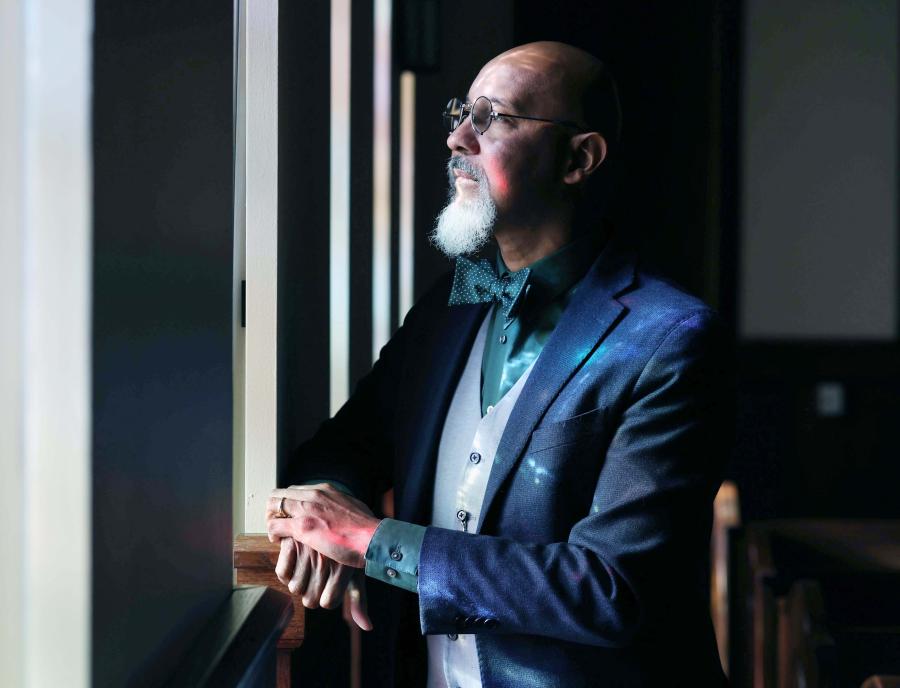
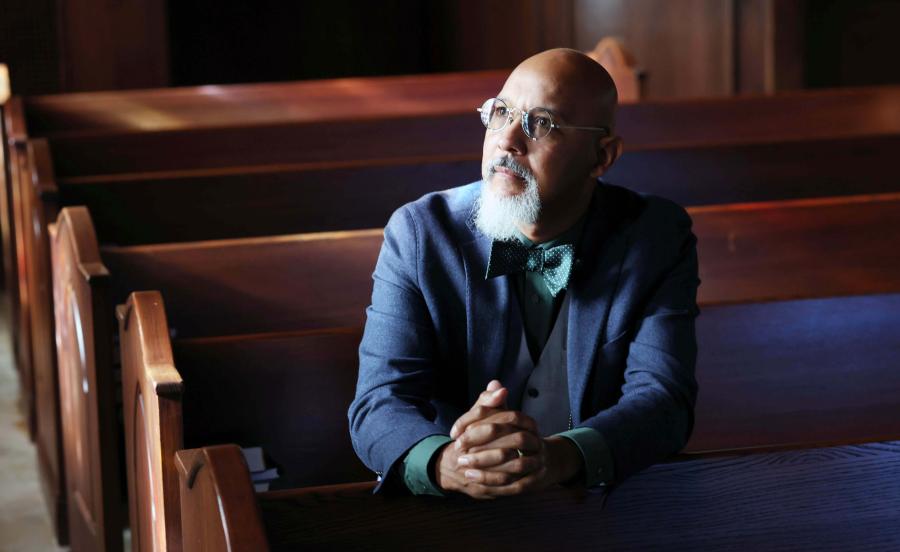
Dr. Ronald Angelo Johnson (Robert Rogers/Baylor University)
A Baylor historian will be using funds provided by a generous alumni donor to do research aimed at filling in significant gaps in the story of Black Baptist worship in North America.
Ronald Angelo Johnson, Ph.D., associate professor of history and The Ralph and Bessie Mae Lynn Chair of History, hopes that his work examining Black Baptist congregations during their earliest days on the continent will pave the way for Baylor to become a strong resource for future scholars wanting to study the history of the faith.
Dr. Johnson joined the Baylor faculty in 2020. He’s an ordained Baptist minister who has pastored churches in Texas and two other states.
“I come at this project as a lifelong Baptist who is ordained in the traditional Black Baptist churches I am researching,” Johnson said. “Black Baptist spirituality and culture is part of who I am and who I’ve always been.”
Besides his ministerial service and years spent as a college history professor, Johnson’s somewhat eclectic résumé also includes his stints as a CIA intelligence analyst, a Navy chaplain and a U.S. foreign service diplomat serving in Europe and Africa.
The history of early America is one of Johnson’s major scholarly interests, and he serves as co-editor of The Journal of the Early Republic. His latest book, “Entangled Alliances: Racialized Freedom and Atlantic Diplomacy During the American Revolution,” published in 2025, is a reinterpretation of the American Revolution that documents the desire of Black people in the United States and Haiti at the time to resist slavery and gain liberty.
Thanks to a fund recently created through a gift of $100,000 from Baylor alumna Ella Wall Prichard of Dallas and Corpus Christi (BA ’63), a history major who served as the editor of the Baylor Lariat, Johnson will be provided the resources needed to “support the study of the origins and evolution of Black Baptist history in North America to 1866.”
A legacy often overlooked
Johnson said that one reason he wants to center his research in North American Black Baptist history in the years leading up to 1866 –– before Reconstruction and the advent of the modern Civil Rights Movement –– is that the surge of interest in modern Black history has revealed that earlier stories of Black Baptists have often been lost or overlooked.
“Many 20th century Civil Rights activists –– such as Martin Luther King Jr., John Lewis and Fannie Lou Hamer –– came out of the Black Baptist tradition, so there’s a lot of scholarly work already done on that period,” Johnson said. “But Black Baptists have been a part of the American story from the very beginning, and they are underrepresented in books on Baptist history.”
One reason that early Black Baptist history has not been as thoroughly researched and documented is that before 1866, many Black Baptist churches were members of white American-controlled denomination associations that did not fully preserve their records. Early Black churches, despite boasting large memberships, typically had to maintain a low profile to survive.
“Many early white American Baptist churches met in wonderfully structured meetinghouses tied to an organized denomination,” Johnson said. “By contrast, before 1866 many Black Baptist churches began by meeting in ‘hush harbors’ –– where dozens of enslaved people on Saturday or Sunday evenings gathered in the woods out of earshot of white American overseers and prayed for deliverance. For example, the first African Baptist Church in Williamsburg, Virginia, came from members meeting outside of town around 1776. I find it meaningful that this Black church body was established in a hush harbor around the same time that Thomas Jefferson, a Virginia slaveholder, was drafting the Declaration of Independence.”
Despite the significant increase in Black Baptists in America during the years leading up to the end of the Civil War, Johnson said that modern histories still tend to downplay their numbers.
“Many of the Black churches during this time were larger in numbers than the white churches,” he said. “When we recall that the majority of Baptists in some areas were Black, yet in the writing of U.S. Baptist history, Blacks are only getting one chapter or a footnote –– we need to do something about that.”
Continental scope
Johnson said that the scope of his research intentionally includes the entire North American continent because early Black Baptists were not confined to the United States.
“The Baptist faith in North America was constantly influenced by the Caribbean, by Africa and by Black sailors on the Atlantic Ocean,” he said. “At the end of the American Revolution, about 20,000 Black people left the United States with the British to secure freedom in Canada and the Caribbean. A Black Baptist pastor, George Liele, left Georgia with the British and became a missionary in Jamaica. Other Black Baptist preachers relocated and started churches in Newfoundland and Novia Scotia.”
Creating a hub at Baylor
While the research being done by Johnson himself aims to help rectify some of these gaps in Baptist story, he said that the Prichard Fund is designed to have an even larger and wider impact, both on Black Baptist scholarship and on Baylor University.
“One of the major things we want to do is mark Baylor as a national hub for the study of early Black Baptist history. The way we want to begin is by hosting the nation’s leading scholars in this field here at Baylor for a symposium,” Johnson said. “We’re also going to bring together the best and brightest graduate students researching this topic, along with local, public and oral historians who have kept the stories of these Black churches alive when no one was paying attention. We want to bring them all together here on campus. Baylor is the right place to do this work.”
Johnson also envisions the creation of a permanent digital archive of the scholarship produced by himself and others.
“Every paper presented at a symposium will be available on a Baylor-hosted website where people can see this work as it becomes available,” he said. “We will make available to readers across the country the research and writings of people working away in scholarly obscurity in ways that are not happening now. I can’t think of anyplace better than Baylor to do this work. We want Baylor to become a place that produces the next generation of researchers and scholars in early Black Baptist history. I see this as part of Baylor’s mission and our spiritual contribution as a Christian research university.”
An impactful gift
Julie deGraffenried, Ph.D., chair and associate professor of history, said the resources that will be made available through the Prichard Fund will provide future students and historians the means to realize that vision and expand on Johnson’s research into Black Baptist heritage.
“Ella Prichard’s gift will have an immediate effect on our ability to begin telling a more complete story of North American Baptist history, and Dr. Johnson is the ideal historian to lead this effort because of his scholarly expertise and academic preparation,” deGraffenried said. “Given our Baptist heritage, Baylor is precisely the place where Black Baptist history ought to be studied.”
(All photographs courtesy of Robert Rogers/Baylor University)
ABOUT THE COLLEGE OF ARTS & SCIENCES AT BAYLOR UNIVERSITY
The College of Arts & Sciences is Baylor University’s largest academic division, consisting of 25 academic departments in the sciences, humanities, fine arts and social sciences, as well as 11 academic centers and institutes. The more than 5,000 courses taught in the College span topics from art and theatre to religion, philosophy, sociology and the natural sciences. The College’s undergraduate Unified Core Curriculum, which routinely receives top grades in national assessments, emphasizes a liberal education characterized by critical thinking, communication, civic engagement and Christian commitment. Arts & Sciences faculty conduct research around the world, and research on the undergraduate and graduate level is prevalent throughout all disciplines. Visit the College of Arts & Sciences website.