

The Art of the Printed Page
Baylor students are learning to use the University’s Book Arts & Letterpress Lab to give new dimensions to their creativity
In an age where printing more and more means creating electronic dots on a screen, and books are either electronic documents or physical items mass produced overseas, students at Baylor University are getting the rare chance to connect to the roots of printing words and images on paper.
The new Baylor Libraries Book Arts & Letterpress Lab, which opened at the start of the 2024-2025 academic year, introduces Baylor students, faculty and staff to historical printing practices, allowing them to create their own books by hand using paper and ink. A number of faculty in the College of Arts & Sciences have now integrated this experience in the courses they teach to provide their students with this transformative learning experience.
Stylish sonnets
When students take Dr. Paul Larson’s Medieval and Early Modern Literature course, part of what they learn is the history of the sonnet –– a type of poem that originated in Italy during the Renaissance.
The sonnet really “hit its stride,” Larson said, in the early 16th century when Spanish poet Garcilaso de la Vega embraced the style in his writing.
“It’s such a great art form,” Larson said.
In the past, Larson has introduced his students to this historic art form by assigning them each a sonnet and asking them to explain it in class using a PowerPoint exposition. But when he taught his Fall 2024 course, he decided to pivot somewhat. “I wanted to make this a little more personal for the students than to just read other people's sonnets,” he said. To that end, he had his students write a sonnet of their own –– composed of 14 lines with about 11 syllables in each line.
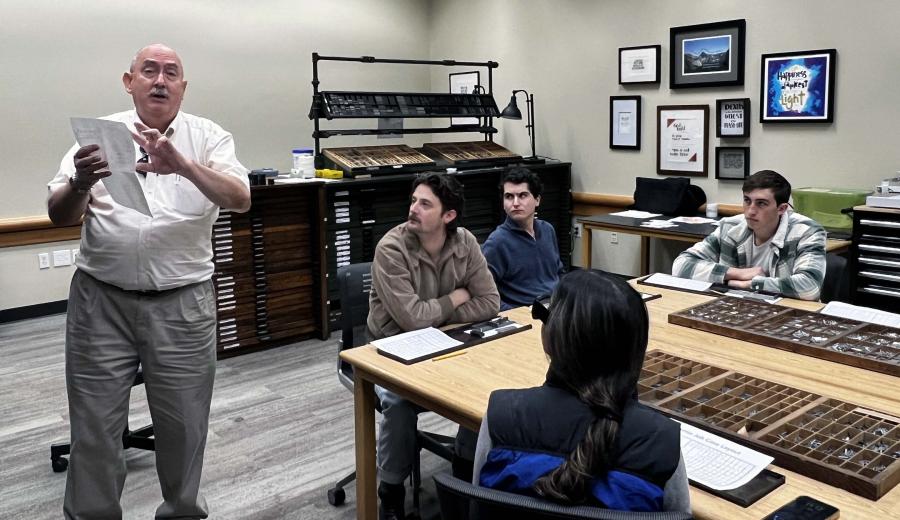
After the sonnets were written, Larson, a professor of Spanish in the Department of Modern Languages and Cultures, took his students on a visit to the book lab so they could work on transforming each sonnet into a pliego suelto –– which is a small booklet created through printing on a single sheet of paper.
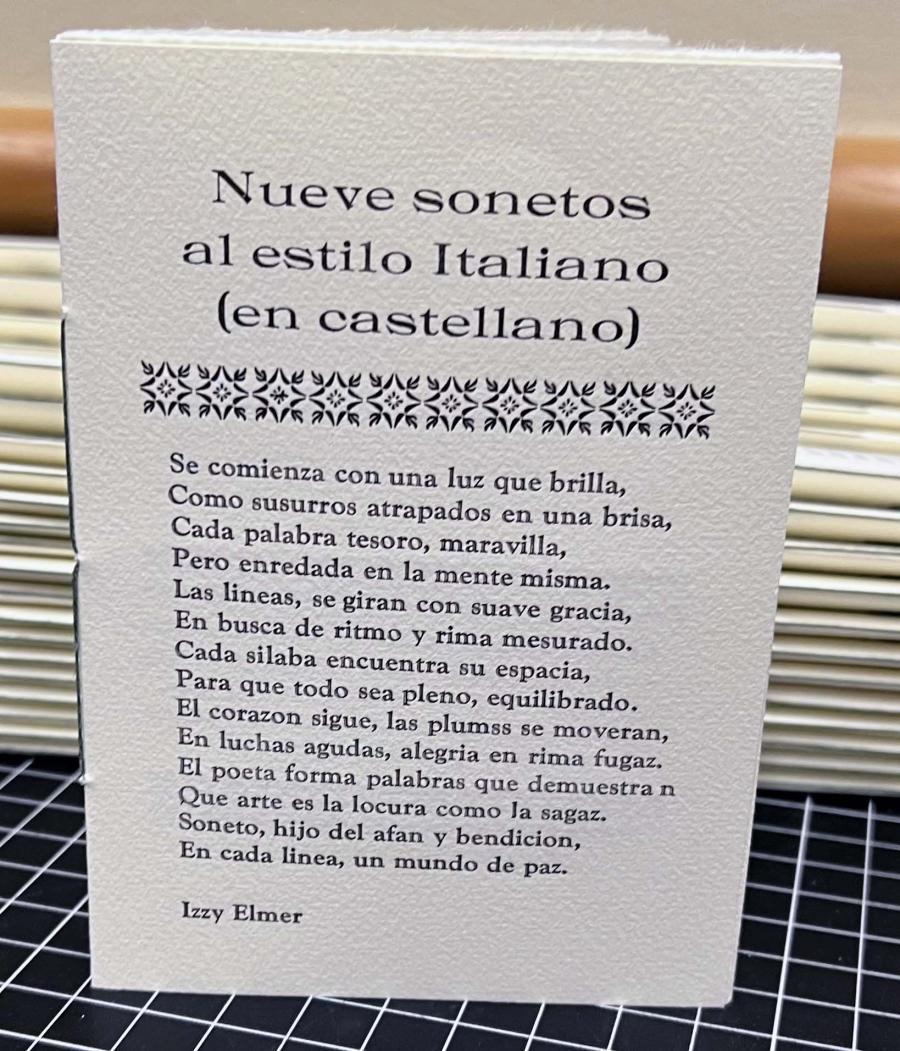
“Poetry lends itself to this particular format very well, because poems are not particularly long,” Larson said.
The pliego suelto also dates back to the 16th century, when booksellers made thousands of the booklets to sell and augment their cash flow.
“They’re very easy and cheap to make,” Larson said. “The bookseller could sell these for a very, very modest price.”
During their time in the lab, Larson’s nine students in the class hand-printed about 70 of the small books. That’s enough for each student to have five copies apiece in addition to several copies to be placed in the University Archives.
“It's going to be preserved in the archives for a good long time,” Larson said. He also presented a copy of the book to Baylor President Linda Livingstone.
Japanese poetry
In her Introduction to Poetry course, Dr. Ginger Hanchey, a senior lecturer in English and Director of the Core in the College of Arts & Sciences, puts an emphasis on having her students read and talk about poems. Her students normally don’t regularly write poems of their own, but in the fall of 2024, she came up with the same idea that Larson did –– to have her students write poems of their own, including examples of Japanese haiku and tanka forms.
Hanchey provided prompts and activities throughout the semester to guide her students as they created their poems, which they all then contributed to a shared Google document.
“Then we had conversations as a class about how poetry books get made,” she said. “Why put one poem on the front page and one poem in the middle? How do the poems link together well?”

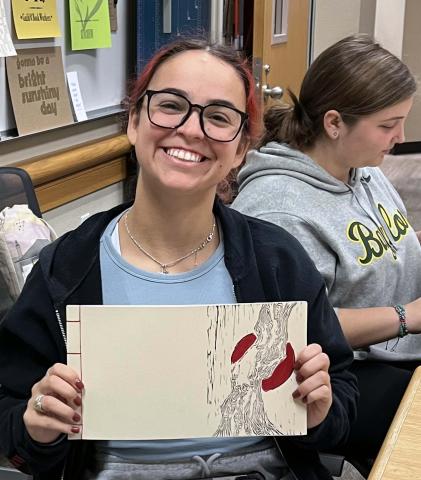
Once those questions had been answered, Hanchey took her students and their poems to the Book Arts & Letterpress Lab, where the class designed and printed a custom book compiling all of the work collected in the Google document.
“Each student was able to typeset their own poems. They even got to sew the spines of their book in a Japanese style that fit the Japanese poetry form we were working in, and we had another student design a Japanese print for the cover of each book,” Hanchey said. “Then we printed them, with enough pages to make a quantity of books so that we all had one, while we the library could keep a couple of extra copies.”
From screens to posters
Virginia Green, associate professor of art, is another Arts & Sciences faculty member who gives her students the chance to further their creativity with a visit to the book arts lab.
Green said she teaches her design students “typography hierarchy, like all aesthetic and formal aspects of type,” and uses programs such as Adobe Illustrator in her graphic design classes. She took her students to the letterpress lab to take part in a hands-on lesson that somewhat replicated the design work they had been doing on a computer screen.
“They understood the vocabulary of points and picas and leading, similar to the experience on the computer,” Green said, “so it was more of a history lesson, plus they got to set type and print it. They all left with a poster they made and were excited about that.”
Green, an experienced letterpress printer herself, shows her students how they can create a polymer plate in a computer program, “and it can be printed on the old, traditional type of printing press that they use in the lab,” she said. “So, I’ve taught them that it’s not just handset type and printing done on those presses. There is a crossover that can happen.”

A crazy idea
The Book Arts & Letterpress Lab is housed in two rooms on the first floor of Baylor’s Jesse H. Jones Library. Sha Towers is the founder and director of the lab, as well as associate dean for research and engagement for the University Libraries.
Towers is also the founder and curator of the Baylor Books Arts Collection, a nationally recognized collection of artists’ books and fine press books which he said allows students to explore “the many ways artists have used the concept and format of the book, including letterpress printing, for creative expression.”

The Book Arts Collection dates from 2007, Towers said, and the idea for a Book Arts & Letterpress Lab “had been percolating for a while” when, in 2023, he saw a notice of a print shop owner in North Carolina shutting down his business and selling all the equipment. Late on a Saturday night, Towers dashed off an email to Jeffrey Archer, dean of University Libraries, museums and Baylor Press, and said, “Look at this crazy thing.” He wasn’t sure what to expect as a reply, but Archer wrote back, “Are you going to do it?”
Even though the North Carolina deal fell through, Towers continued his search for vintage printing equipment. He soon found a couple of 19th century presses in Austin that the library acquired in December 2023.
“That got the ball rolling quickly and we spent all summer of 2024 just working around the clock to get this thing up and running and collecting all the tools and equipment we needed so that we could open the doors in the fall of 2024,” Towers said. “That’s when we opened the lab for business.”
Confounding expectations
And business has been brisk for Towers and Jeanne Dittmann, the lab coordinator who manages projects and classes. During the 2024-2025 academic year, the lab had more than 2,100 engagements with Baylor students. During the year, there were 36 sections of 29 unique courses from Arts & Sciences disciplines such as art and art history, journalism, medical humanities, English, religion, Spanish, theatre arts and museum studies. The lab now contains 13 presses from the 19th to the 21st centuries, and users can choose from about 300 different fonts –– some that have been newly created, and others that are 200 years old.
Willow Cunningham, a freshman English major, took part in a group project in the Book Arts & Letterpress Lab while taking a course on British literature in the spring of 2025. She said creating in the lab changed her outlook on the written word.
“It made me think about literature and communication not as content, but also as craft –– something designed and built, letter by letter,” she said.
Towers said that what makes a project in the letterpress lab appealing is that it’s so different from anything else students have done before.
“In other classes, students are making things too,” Towers said. “They write a paper, they turn it in and get a grade –– but they’re not keeping that paper for the rest of their life. Maybe creating something in the lab is just so different than the traditional experience and expectation that it creates a kind of disruptive moment in their learning and education. It’s just different enough from the norm that it really stands out.”
This article originally appeared in the Fall 2025 issue of Baylor Arts & Sciences magazine.
ABOUT THE COLLEGE OF ARTS & SCIENCES AT BAYLOR UNIVERSITY
The College of Arts & Sciences is Baylor University’s largest academic division, consisting of 25 academic departments in the sciences, humanities, fine arts and social sciences, as well as 11 academic centers and institutes. The more than 5,000 courses taught in the College span topics from art and theatre to religion, philosophy, sociology and the natural sciences. The College’s undergraduate Unified Core Curriculum, which routinely receives top grades in national assessments, emphasizes a liberal education characterized by critical thinking, communication, civic engagement and Christian commitment. Arts & Sciences faculty conduct research around the world, and research on the undergraduate and graduate level is prevalent throughout all disciplines. Visit the College of Arts & Sciences website.