

The Buildings of Arts & Sciences -- Part One
This is the beginning a multi-part series that will continue through future issues of Baylor Arts & Sciences magazine. The series will give our readers a brief overview of the 15 different campus buildings which house (totally or in part) programs within the College of Arts & Sciences. In the first installment, we look at three of the oldest structures remaining on Baylor’s Waco campus.
Old Main (1887)
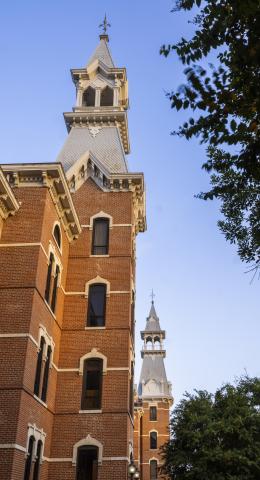
Baylor University began its life in Independence, Texas, but within a year after it was relocated to Waco in 1886, what was known simply as either the Main Building or the University Building was the only structure on the campus. Completed in 1887, "Old Main" housed all classrooms and laboratories, as well as all faculty and administrative offices (including the office of President Rufus C. Burleson, where Baylor’s first telephone was eventually installed). The third floor was originally Baylor’s chapel and auditorium, where chapel services, musical concerts, dramatic presentations and other gatherings were held.
After the Carroll Chapel and Library building opened in 1902, the third floor of Old Main was transformed from a chapel into a women’s gymnasium.
In the 138 years since it opened, Old Main has housed many academic units, departments and programs for a time, including Baylor’s business school, speech department, campus radio station and TV studio, and even an underground armory that stored weapons used in student military training programs. In 1951, a large antenna mounted on the roof serviced Baylor’s first television set –– and was the tallest antenna at the time in Waco. It has also provided offices for the Baylor Lariat newspaper and Round Up campus annual.
Old Main has survived at least two attempts by Baylor administrators to tear it down in order to construct new buildings in its place. Today, it houses the Department of Modern Languages and Cultures in the College of Arts & Sciences, and is also shelter for one of the largest feral cat colonies on campus.
Burleson Hall (1888)

Georgia Burleson Hall, named after the wife of Baylor President Rufus Burleson, opened in September 1887 as the second building on campus. It was also Baylor’s first dormitory, open exclusively to women and dedicated to “female education and piety,” according to the inscription on its cornerstone. Georgia Burleson served as the first matron of the dormitory.
The three-story structure contained parlors where female students could receive guests and programs could be held. In later years a bakery, kitchen and dining hall were added on to the building, and for a time the dormitory was also home to the Baylor Women’s Hospital. In the 1930s, one room in the hall displayed furniture and other belongings of University co-founder and namesake Judge R.E.B. Baylor.
During World War II, Burleson Hall’s rooms housed male Navy personnel who were receiving training on campus. Sometime after the war, the dormitory was reserved for senior women only, and then in 1958 it briefly became a male-only dormitory.
In 1960, Burleson Hall ended its days as a residence hall and began housing a long series of academic and administrative offices, including the Baylor Counseling Center, Office of Development, Office of Public Relations, Speech-Therapy Clinic, Purchasing Office and BSU Missions. It also survived at least one plan to demolish it for new buildings, and both it and Old Main were fully renovated in the mid-1970s.
Today, Burleson Hall is home to the College of Arts & Sciences Dean’s Office and supporting administrative offices, as well as the Department of Political Science within the College.
Carroll Science Building (1903)
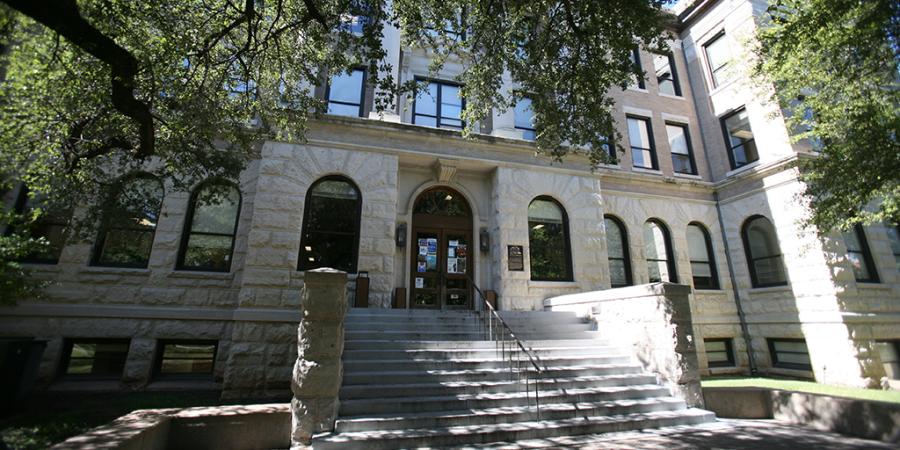
In April 1903, Baylor University dedicated two new buildings, both made possible by generous gifts from members of the Carroll family of Beaumont, Texas –– the F.L. Carroll Chapel and Library, and the George W. Carroll Science Building.
When it opened, Carroll Science contained all of the science classrooms and laboratories and science faculty offices of the University. It was also home to the relocated office of Baylor President Samuel Palmer Brooks. Over the past 120 years it has housed the University Press and Bindery, the Baylor Museum (located in the basement), the Baylor Bookstore, the campus mail service, the central duplicating office and various non-science academic offices.
After new science buildings opened on campus in the 1960s, Carroll Science became home to the Department of Art in the College of Arts & Sciences. The Baylor Art Museum –– later renamed the Martin Museum of Art –– opened there in 1968.
When Baylor’s Hooper-Schaefer Fine Arts Center opened in 1981, the art department moved out of Carroll Science and was replaced by the Department of English in the College of Arts & Sciences, which is the sole occupant today. The building received an extensive renovation in the early 1980s, with assistance from a lead gift made by Gov. Bill and Vara Daniel of Liberty, Texas.
This article originally appeared in the Fall 2024 issue of Baylor Arts & Sciences magazine.
ABOUT THE COLLEGE OF ARTS & SCIENCES AT BAYLOR UNIVERSITY
The College of Arts & Sciences is Baylor University’s largest academic division, consisting of 25 academic departments in the sciences, humanities, fine arts and social sciences, as well as 11 academic centers and institutes. The more than 5,000 courses taught in the College span topics from art and theatre to religion, philosophy, sociology and the natural sciences. The College’s undergraduate Unified Core Curriculum, which routinely receives top grades in national assessments, emphasizes a liberal education characterized by critical thinking, communication, civic engagement and Christian commitment. Arts & Sciences faculty conduct research around the world, and research on the undergraduate and graduate level is prevalent throughout all disciplines. Visit the College of Arts & Sciences website.