

Research Shines Bright at the Mayborn Museum
Visitors to Baylor’s popular natural history museum get to learn first-hand about important research being done on campus
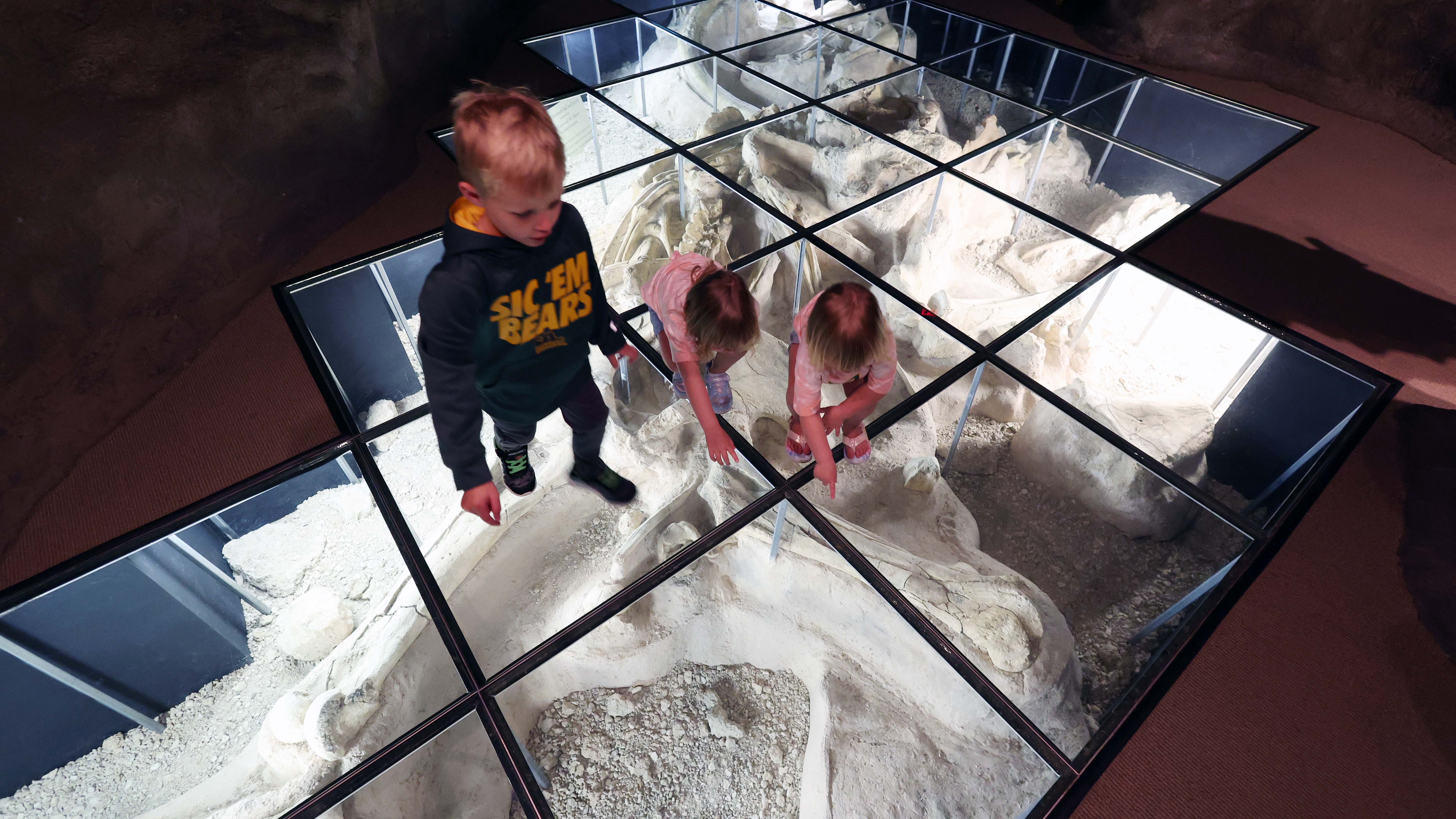
Baylor research into mammoth bones found in Waco is highlighted in Mayborn Museum exhibits
If you stand by the plaza in front of Baylor University’s Mayborn Museum, you can’t help but notice the life-size statues of a family of mammoths –– bronze sentinels seemingly keeping watch over both the priceless scientific collections inside, and the valuable collaborations which exist between the museum and researchers across the University.
The bones of real mammoths, unearthed at what is now the Waco Mammoth National Monument six miles to the northwest, are housed at the museum where Baylor researchers examine and study what happened to them tens of thousands of years ago. This is but one of many examples of Baylor faculty collaborations with the Mayborn –– in fields ranging from sleep science and water conservation to native peoples and space exploration.
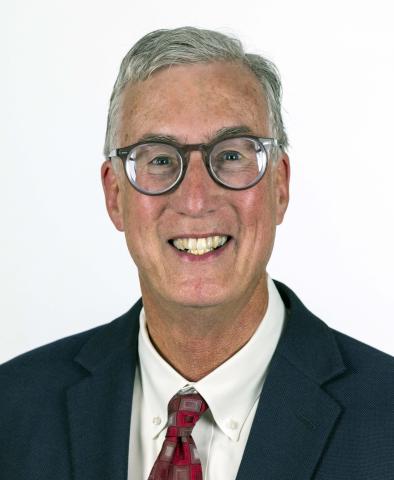
“We’ve made it a goal to weave Baylor research into all the exhibits we’re working on,” said Charles Walter, executive director of the Mayborn Museum. “It’s been one of the pillars of our strategic plan over the past 10 years to support Baylor research, support Baylor R1 and continue to connect Baylor to the community.”
Portal to the Public
A key piece of that effort is Portal to the Public, a collaboration between universities and museums funded by the National Science Foundation which was introduced at Baylor in 2015 when Walter arrived at the Mayborn.
“Portal to the Public helps researchers, No. 1, to engage visitors, but No. 2, there’s a whole science behind informal learning,” Walter said. “Informal learning is learning outside of the formal classroom and usually involves real objects, real experiences.”
The Portal to the Public program provides training three times each semester to Baylor faculty and students. In 2025 approximately 50 persons completed the three-and-a-half-hour curriculum, and 2026 has been trending much the same.
“We teach strategies for communicating complex ideas or complex research to museum visitors,” said April Love, who is working on a master’s degree in museum studies while serving as the broader impacts and volunteer engagement manager for the museum. “We also teach engagement strategies, which is the same engagement training everybody gets who interacts with a visitor at the Mayborn.”
The goal is to help researchers become comfortable sharing their work outside the classroom with audiences often unfamiliar with scientific jargon and processes.
“It’s common for our researchers to feel, ‘How on earth am I going to talk about something that’s taken me years and years to understand? I’m going to talk about that in five minutes to a seven-year-old?’,” Love said.
The training helps participants to be able to explain their research in one sentence –– a scientific elevator speech, if you will –– and teaches them how to attract and keep a visitor’s attention using three goals of engagement:
- Go Slow ––greet visitors with eye contact and welcoming body language so they’ll slow down and check out the activity or exhibit;
- Look Closer –– ask productive, low-risk questions that invite visitors to look closer; and
- Dig Deeper –– build conversation with complex questions, encouraging visitors to dig deeper.
“At the end of the training we get the researchers started on thinking about what kind of activity they could do with the public in the museum,” Love said.
Since 2016, 460 faculty, students and staff members have completed the training, with those who share research with visitors referred to as Mayborn Research Partners. For the first 10 years the training was aimed mostly at researchers in the STEM (Science, Technology, Engineering and Mathematics) fields, but now the program has expanded to other disciplines –– a total of 16 in all, including some such as English, journalism and business that might seem a bit surprising.
“We want to be more surprised. We want to train somebody from a department at Baylor we haven’t even imagined yet,” Love said. “The communication strategies we teach are good for anybody, because if you can make successful connections on the museum floor, you can do it anywhere.”
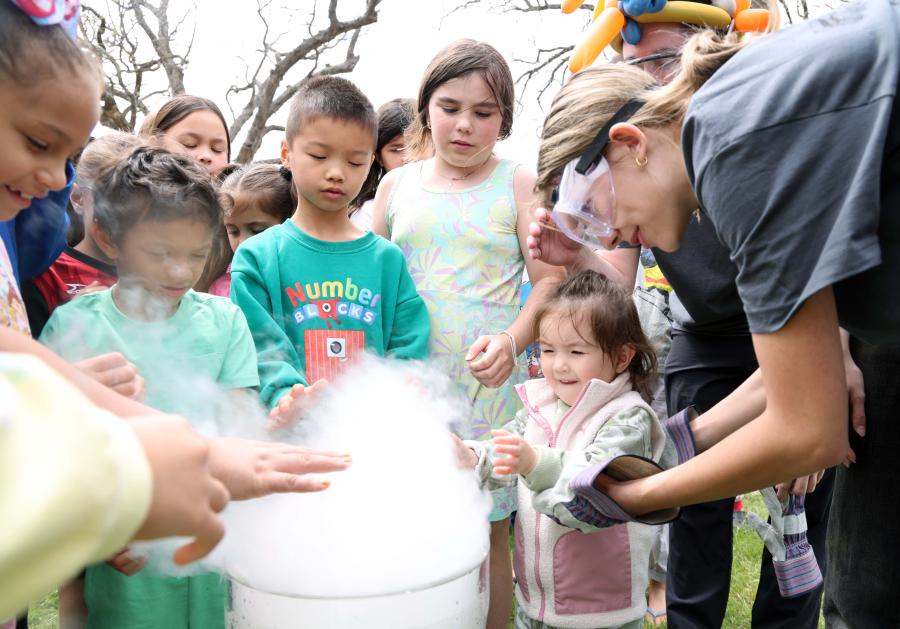
After the training, research partners are invited to show their work at events such as Baylor’s SIC’EM Science Day each spring, which typically attracts 600 to 800 visitors, said Molly Noah, marketing coordinator for the Mayborn. Visitors include the general public as well as school groups, such as a middle school science club from Gatesville that has been coming for 12 years.
Walter said that between 200 and 300 groups from almost 100 area school districts visit the Mayborn each year.
“There are only 20 school districts in McLennan County, so we’re drawing from the counties all around us. We are a big education resource,” he said. “And, it’s another great way to introduce people to Baylor at that young age –– getting them on campus and showing them, ‘Here’s some research happening right here.’”
Another way researchers are encouraged to present their work to museum visitors is through “Meet the Scientist” pop-up demonstration programs.
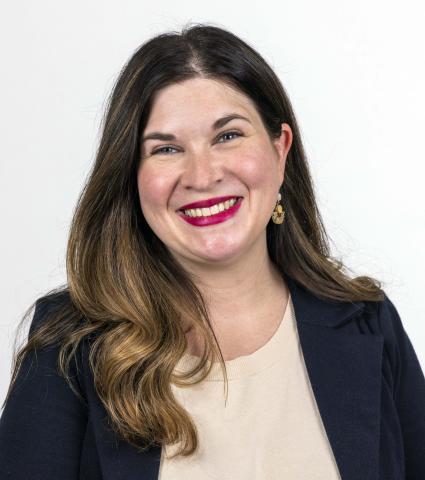
“Meet the Scientist pop-ups are fun for the researchers and the public, but there also is a serious grant funding side to these events, known as ‘broader impacts,’” said Rebecca Tucker Nall, the museum’s assistant director of exhibits, communication and visitor services. She said that National Science Foundation (NSF) research grants are awarded based on intellectual merit and the broader impact of research, which includes how findings are shared with the public.
“Applicants have to prove they have educational goals and a plan to directly connect with the public and talk about their research,” Nall said. “The Portal to the Public training goes into their NSF grant, and Meet the Scientist is usually one of the first things they put in there where they're talking about their public activities.”
Mayborn staff help those applying for grants by writing letters of collaboration, which document broader impact plans and activities. Through the first two quarters of fiscal 2026, museum staff had written 16 letters of collaboration for grant proposals. In a recent case, a physics professor’s research grant request was approved for funding, and the feedback on his application indicated that his statement of broader impacts was one of the most compelling elements, Love said.
“That makes us feel good because it means we’re doing our part in helping them get the training and strengthening their research grants,” she said.
Boosting the Baylor connection
Ongoing surveys indicate that 42 percent of visitors to the Mayborn Museum learn about Baylor research while they are there. Walter said that points to a significant shift in the museum’s focus.
“When I came here, you could have walked into the Mayborn and it could have been a museum in Fort Worth or Dallas or San Antonio,” he said. “It was a very generic museum –– a great place –– but as we talked we wondered, ‘How do we make sure people know this is a Baylor museum?’”
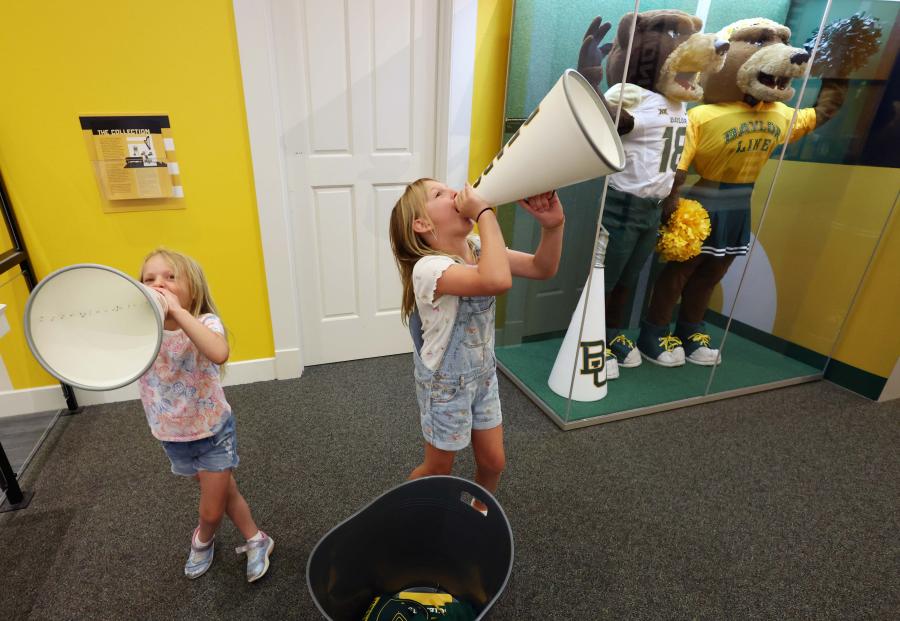
The answer has come through hosting exhibits such as “Founding to Future: Bright Lights of Baylor University,” celebrating the University’s 175th anniversary, and through new temporary and permanent exhibits that highlight recent Baylor research.
“Sleep Lab: The Exhibit,” showcased the research of Dr. Michael K. Scullin, professor of psychology and neuroscience and director of Baylor’s Sleep Neuroscience and Cognition Laboratory. The exhibit was funded through the broader impacts provision of Scullin’s research grant.
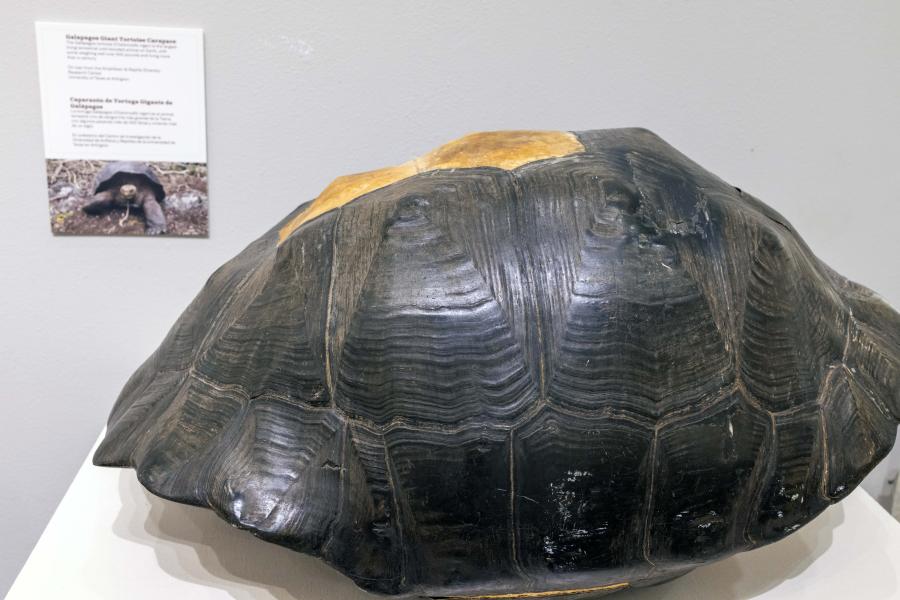
Another Mayborn exhibit, “One Health: Galápagos” which highlights the research trips to the Galápagos Islands led by Dr. Michael Muehlenbein, professor of anthropology, was a partnership with the Department of Anthropology in the College of Arts & Sciences and Baylor’s Center for Global Engagement.
“In both cases the professors proposing the exhibits contacted us. They love being in the museum, they know about our audience, and they wanted to connect more broadly,” Walter said. “We’re open to anybody who calls.”
A major renovation project completed in the spring of 2026 made room for “Cultural Crossroads,” a 5,000-square-foot permanent gallery exploring the people, cultures and innovations shaping the Waco region. It features an authentic grass house similar to those that the Wichita and affiliated tribes built on the banks of the Brazos River hundreds of years ago.
“We had a number of Baylor faculty who were advisors to that project based on their field of study. They reviewed content, text, photographs and maps for us and gave us feedback,” Walter said.
The museum has plans for future permanent exhibits about Baylor research in ecology and showcasing “Baylor in the World.”
Collection-based research
As the guardian of some 200,000 objects in its natural history and cultural history collections, the Mayborn Museum hosts two Bryce C. Brown Research Fellows every summer who are given access to those objects for their research. The fellowship is named for the late Dr. Bryce C. Brown, a former director of the Strecker Museum (Baylor’s predecessor of the Mayborn), and is funded by Leo Brown, Dr. Brown’s son and a museum volunteer.
“Fellows have included everyone from Dr. Bracy Hill in history, who was exploring hunting culture, to Dr. Dan Peppe in geosciences, who created a teacher training workshop using our paleontology collections,” Walter said. “Kaz Hayashi, a doctoral candidate in religion, looked at our ancient Near East artifacts and researched their inscriptions.”
Noah said the Brown Fellowship was recently enhanced with a teaching component.
“Our Fellows now receive Portal to the Public training as part of their fellowship, and they then have the opportunity to learn from our museum staff about how to teach from our collections,” she said.
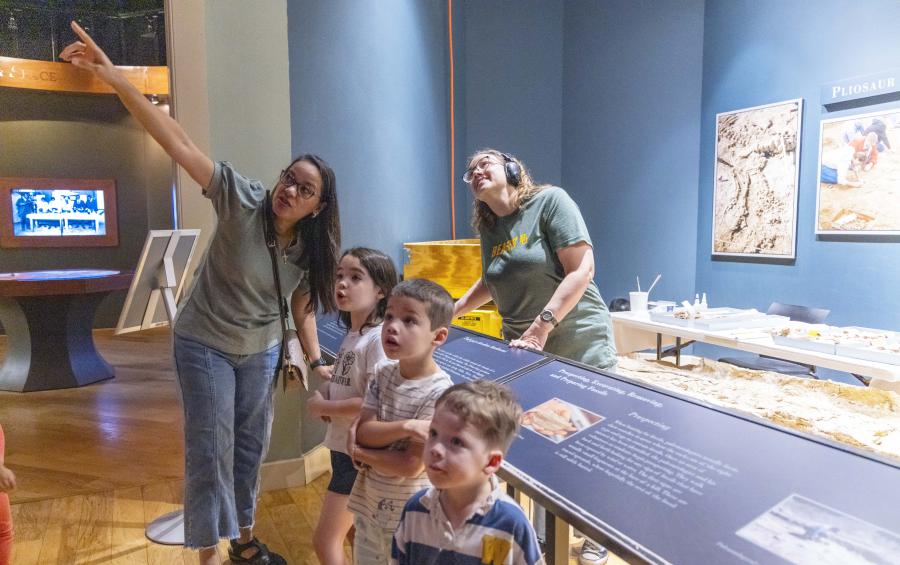
Some researchers come to the Mayborn already equipped to engage the public. Dava Butler, a doctoral candidate in geosciences and a Bryce C. Brown Fellow, helped create Fossil Fridays, yet another popular program that brings museum visitors in direct contact with Baylor research.
“I’m part of the Waco Mammoth National Monument research group,” Butler said. “The monument has produced at least 30 Columbian mammoths so far, and we’re trying to learn as much as we can about how they lived and died 67,000 years ago. My work has focused on the health condition of each of the mammoths, and what population health tells us about the environment.”
Working in the museum’s paleontology lab, Butler enjoys interacting with museum visitors, having received plenty of practice as a public educator at the national monument.
“For nearly 10 years, I coordinated school field trips and led educational activities that I developed for the park,” she said. “I missed working with the public, so I approached staff members at the Mayborn to ask whether I could create a Fossil Friday program.”
Butler said she welcomes the opportunity to introduce young students to science.
“I grew up in Waco, and field trips to the Strecker Museum are some of my fondest childhood memories,” she said. “I want to recreate that experience for kids who visit the Mayborn Museum, and I want them to see science in action. Maybe one of them will be inspired to return when they’re older and help us continue learning about our mammoths.”
The Mayborn’s mammoth collection will soon be joined by a dinosaur trackway found on a ranch west of Waco.
“Dr. Peppe is working with us to excavate that trackway and bring it to Baylor,” Walter said. “He’s one of Dava’s major professors, so the connections are wonderful that way.”
Butler said that her academic co-advisor with Dr. Peppe is Dr. Lindsey Yann, paleontologist at the Waco Mammoth National Monument, who also has been instrumental in recruiting researchers to the Mayborn.
The Mayborn Museum also serves as a repository for artifacts and specimens collected by faculty researchers who are retiring or have run out of lab space.
“We get requests from professors –– ‘Can you house my collection?’ –– because that’s what we do,” Walter said. “We are an accredited museum. We take care of things at the highest level of the museum industry.”
(All photographs are courtesy of Baylor Photography)
None of the original writing contained in this story was created with the use, in whole or in part, of artificial intelligence (AI).
ABOUT THE COLLEGE OF ARTS & SCIENCES AT BAYLOR UNIVERSITY
The College of Arts & Sciences is Baylor University’s largest academic division, consisting of the School of Earth and Environmental Sciences and 24 academic departments in the sciences, humanities, fine arts and social sciences, as well as 12 academic centers and institutes. The more than 5,000 courses taught in the College span topics from art and theatre to religion, philosophy, sociology and the natural sciences. The College’s undergraduate Unified Core Curriculum, which routinely receives top grades in national assessments, emphasizes a liberal education characterized by critical thinking, communication, civic engagement and Christian commitment. Arts & Sciences faculty conduct research around the world, and research on the undergraduate and graduate level is prevalent throughout all disciplines. Visit the College of Arts & Sciences website.