

Baylor Model United Nations Team Named an Outstanding Delegation at International Conference
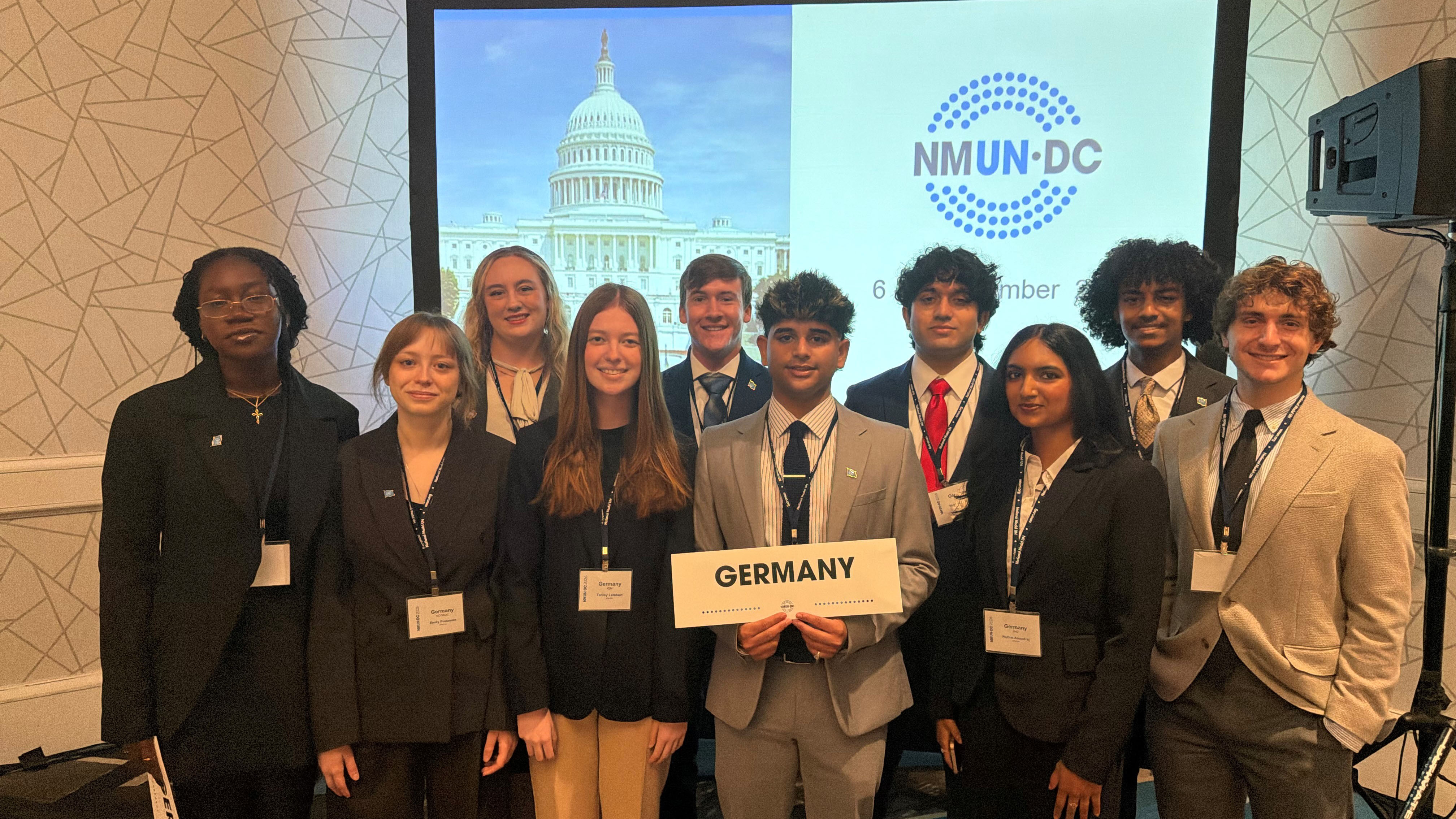
Baylor University's Model United Nations team was named an Outstanding Delegation at a conference in Washington, D.C.
On November 6-8, 2026, 10 members of Baylor University’s Model United Nations Team traveled to Washington, D.C. for the National Model United Nations Conference, where approximately 800 university students from three continents simulated the work of eight United Nations Committees.
At the conference Baylor’s team was named an Outstanding Delegation by conference staff, which is the highest team award given at conference. An Outstanding Delegation award is commendable in any year, but for this team it is especially impressive, as only one of the students on the team had participated in this conference before and only two others had attended any conference in the past. Thus, the team is comprised of mostly young and inexperienced delegates.
The team award was for the students’ work representing Germany in six committees with topics covering the range of the UN’s program of work in international security, sustainable development, and human rights. The team began its preparations for conference in August and submitted researched position papers on two topics per committee approximately a month in advance of the conference. One of these papers for the UN Environmental Assembly received an Outstanding Position Paper Award (see below).
At the conference delegates chose one of the two topics for deliberation at the conference during which students collaborated on resolutions to address the challenges associated with the global issue. The six topics Baylor students worked on with their peers from other schools focused, in particular, on the challenges and opportunities presented by technology, including artificial intelligence (AI), as well as addressing impediments to sustainable development presented by global conflict:
- Artificial Intelligence in the Military Domain and its Implications for International Peace and Security (General Assembly First),
- Combating Illicit Financial Flows and Strengthening Good Practices on Assets Return to Foster Sustainable Development (General Assembly Second),
- Environmental Sustainability of Artificial Intelligence Systems (United Nations Environment Assembly),
- Ensuring Access to Quality Education in Conflict and Post-Conflict Zones (Economic and Social Council),
- Facilitating Pathways for Regular Migration (International Organization for Migration) and
- Combating Technology-Facilitated Violence Against Women and Girls (UN-Women).
During the conference Baylor students gave speeches in front committees that ranged in size from 75 to more than 150 students, and worked collaboratively to draft resolutions in working groups that were comprised of approximately 10-30 students, but supported by the majority of the committee. Across the eight committees at conference approximately 60 resolutions were adopted.
While I am delighted to share the news about the students’ award, it is important that I emphasize the educational value of Model UN conferences. If our students came home empty-handed, this would not mean the experience was any less rewarding. The conference requires our students be well-prepared with research and possess qualities that real-word diplomats use in their work: negotiation, compromise, and tenacity.
As co-head delegate for the conference, Devynn Martin (Senior, International Studies) shared that “MUN is always an amazing opportunity to learn the depths of your ability to lead in the midst of chaos, collaborate in the midst of dissension, and rise to challenges you didn’t think yourself capable of.”
First-time delegate, Ayaan Ansari (Junior, Political Science) shared that “NMUN-DC showed me that diplomacy happens in the moments between speeches. Over three days, more than 40 delegations with very different interests found common ground on one of the hardest questions of our time, and being part of that was the best lesson in negotiation I could have asked for and taught me more than any classroom could.”
This conference is the first of three competitive meetings Baylor’s Model UN team will attend this academic year. Later this month, eight members of the team will travel to the National Model United Nations Conference in Barcelona, Spain, where students will debate topics related to global sustainability in four committees while representing Germany, and in March fourteen team members will participate in the NMUN-New York representing Jordan in seven committees.
Baylor’s Model UN Team is grateful for the support we receive from the Department of Political Science and the College of Arts & Sciences, without which students would not be able to participate in these conferences. For more information about our team, visit our website, or follow us on social media: Instagram (baylormodelun) and Facebook (Baylor Model United Nations).
Outstanding Position Paper Award Winners – United Nations Environmental Assembly:
Owen Osborne, Liz Osornio Morounfoluwa Oyadotun*, Mustafa Salman* and Liv Tantalo, with editorial assistance from Gianna Bolla, Fall 2026 Baylor MUN co-head delegate
(* traveling team member)
Identification of students in delegation team photo above:
Front row (L to R): Morounfoluwa Oyadotun (Sophomore, Astrophysics); Emily Pretzman (Sophomore, Political Science); Tenley Lambert (Sophomore, International Studies); Ayaan Ansari (Junior, Political Science); Ruthie Anandraj (Junior, International Studies & Arabic); William Carlton (Junior, Secondary Education – Social Studies)
Back row: (L to R): Devynn Martin (Senior, International Studies); Zach Henry (Junior, University Scholar & Political Science); Mustafa Salman (Sophomore, Political Science); Yafet Nagesh (Sophomore, Political Science & Economics)
ABOUT THE COLLEGE OF ARTS & SCIENCES AT BAYLOR UNIVERSITY
The College of Arts & Sciences is Baylor University’s largest academic division, consisting of the School of Earth and Environmental Sciences and 24 academic departments in the sciences, humanities, fine arts and social sciences, as well as 12 academic centers and institutes. The more than 5,000 courses taught in the College span topics from art and theatre to religion, philosophy, sociology and the natural sciences. The College’s undergraduate Unified Core Curriculum, which routinely receives top grades in national assessments, emphasizes a liberal education characterized by critical thinking, communication, civic engagement and Christian commitment. Arts & Sciences faculty conduct research around the world, and research on the undergraduate and graduate level is prevalent throughout all disciplines. Visit the College of Arts & Sciences website.