

Atomic Atlas
Baylor’s Transmission Electron Microscope enables important discoveries to be made by faculty and student researchers
For researchers in Baylor University’s College of Arts & Sciences, discovery often begins where human vision ends. The relentless pursuit of obtaining new knowledge through research serves as a cornerstone of the University’s Christian mission, and it continues to establish Baylor as a rising force in the world of scientific discovery.
One of the key elements in Baylor’s successful research endeavor resides inside the iconic Baylor Sciences Building (BSB). The purpose of the Center for Microscopy and Imaging (CMI) is to give faculty and student researchers assistance by providing them access to a variety of state-of-the-art scientific equipment.
Leap of faith
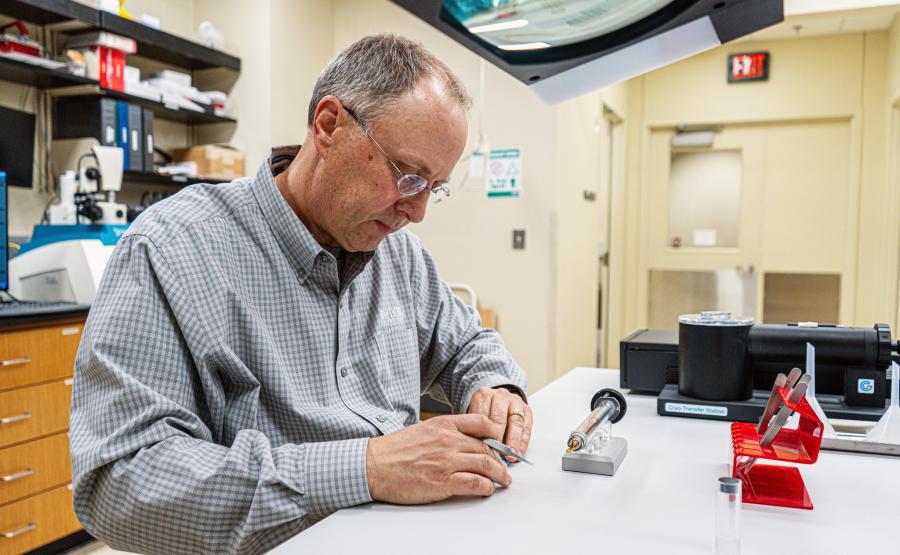
The director of the Center is Dr. Bernd Zechmann, who joined the Baylor University faculty in 2014. At the time, Baylor was still seven years away from achieving R1 status –– the highest ranking defined as “Doctoral/Very High Research Activity” awarded by the Carnegie Classification of Institutions of Higher Education. But the advanced research already taking place then had given Zechmann the confidence to begin a new chapter in Waco.
“I was very much inspired by the motivation and excitement that was present at Baylor in 2014 to reach R1 status,” Zechmann said. “There was a lot of positive energy and motivation, as well as prayers and a lot of resources and money, focused on that specific goal.”
Zechmann said that the dedication of faculty within the BSB such as Dr. Ann Rushing, now a professor emeritus of biology, helped Baylor launch the CMI and served as one of several catalysts toward what the University had always aspired to become. And after R1 status was granted in December 2021, even more state-of-the-art technology began to arrive on campus.
The latest addition to the CMI is the $8 million Transmission Electron Microscope (TEM), which can reveal a world invisible to the human eye. The TEM allows researchers to analyze materials and structures at the atomic level. They can use it as an “atlas” to look at a variety of scientific problems, including mapping how materials behave, examining cancer cells, studying viruses, and analyzing the extremely tiny substances known as nanomaterials.
Game-changing technology
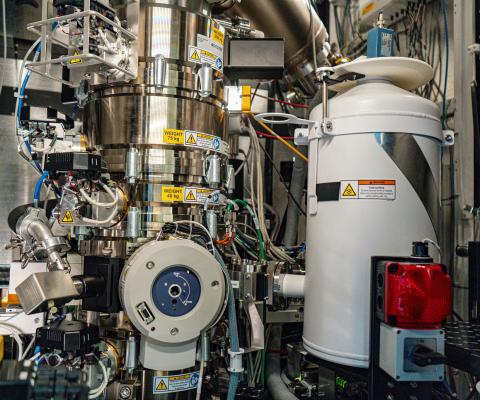
At the time the transmission electron microscope was installed in the CMI in 2023, Baylor and UCLA were the only two universities in the United States with a TEM so powerful and sophisticated.
“When I learned it was going to be installed here, I was really excited because it’s a very high-quality microscope, and it allows you to resolve things that are otherwise very challenging to see,” said Dr. Jonathan Clinger, assistant professor of chemistry and biochemistry.
“I started working with the TEM in the summer of my second year of my Ph.D. studies, and the first time I saw it, I thought, ‘I’m going to break this,” said Laura Kusumo, a doctoral candidate in psychology. “But Dr. Zechmann is an amazing teacher.”
Once the microscope was installed, Baylor researchers knew it would allow the University to fortify its claim as one of the premier research institutions in Texas. In the three years since its arrival on campus, it has already made possible some discoveries that lead to the “jaw-dropping” moments researchers dream of experiencing.
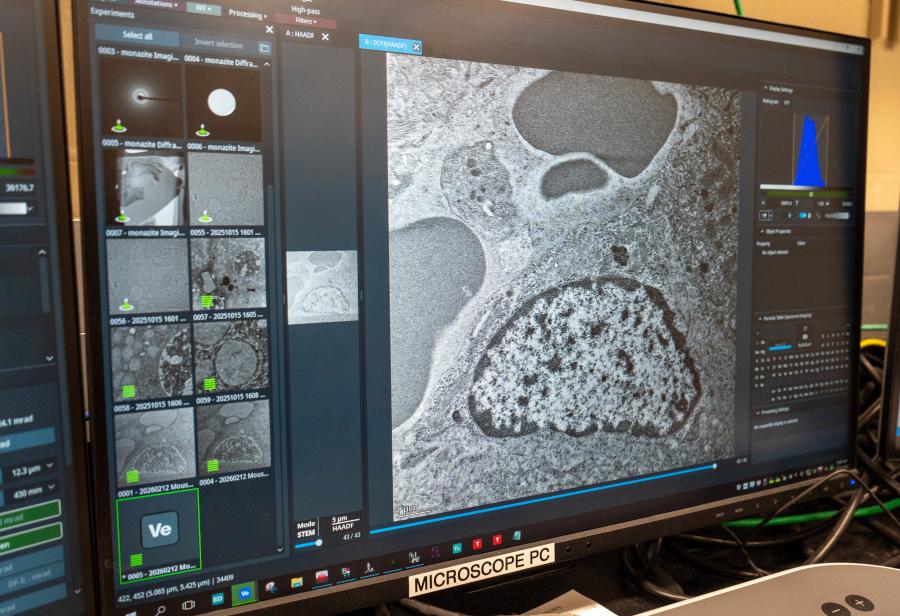
“One of my first ‘wow’ moments with the TEM was capturing an image of mitochondrial blebbing, which is indicative of dysfunction,” Kusumo said. “Another moment that stood out was seeing a sagittal cut of a neuron, where you could actually watch mitochondria being transported down the axon.”
“We mixed catalytic nanoparticles with plasmonic nanoparticles, and we found that the material completely melted,” said Dr. Zhenrong Zhang, professor of physics. “The melting point should be close to 3,000 degrees Celsius, so something was wrong, and we wanted to know why. That’s where the TEM played a critical role.”
It’s not only Baylor faculty who benefit from use of the TEM. The high-powered microscope is key tool providing for student learning experiences across several Baylor courses and programs housed inside the BSB. While the novelty has faded with time, the excitement and interest shown by students who are trained to operate the microscope remains as high as ever.
“Every semester, I have double the amount of students who would like to take the course than seats available,” Zechmann said. “We have trained about 50 users in the last two years, which is roughly the same number we trained (to use CMI equipment) in the previous 10 years. There is a tremendous desire from students to learn how to use this microscope.”
Interdisciplinary impact
A key focus of Baylor’s current strategic plan, Baylor in Deeds, is broadening interdisciplinary research and its impact. The TEM serves as a foundational piece to help fulfill that commitment, as its interdisciplinary applications across the College of Arts & Sciences stretch through the fields of biology, chemistry, physics and environmental science.
“Through our SEA-PHAGES program, students isolate bacterial viruses from the soil and learn the full process –– microbiology, preparation and imaging,” said Dr. Tamarah Adair, senior lecturer in biology and director of undergraduate research in Baylor’s Office of Engaged Learning. “They know the virus is there based on how it grows, but they can’t actually see it until they bring it to the electron microscope.”
But before eager students and researchers can begin working with the giant electron microscope at the heart of the CMI, there is a learning curve to overcome.
“The training is pretty arduous. Students usually spend about a week just learning how to operate the microscope,” Clinger said.
“I was first trained on an older microscope that was very manual, so I learned the fundamentals early on,” said Kayla Haberman Marek, who used the new TEM at Baylor in her cancer research before graduating with a Ph.D. in biology in 2025. “Now with the new TEM, everything is more automated and efficient, but you still need to understand the basics behind it.”
Future benefits
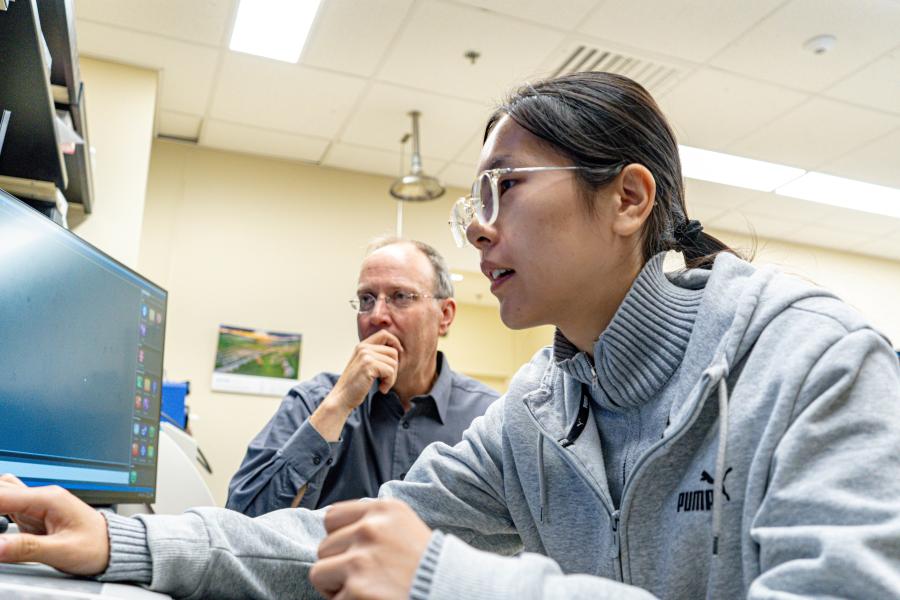
Current researchers at Baylor are confident the training students receive today through both their coursework and hands-on experience with the TEM can help them achieve their future goals.
“I think we prepare them very well for worldwide leadership in their respective fields,” Zechmann said. “If a student can operate an $8.5 million microscope and put that on their professional résumé, it naturally improves their competitiveness. But more importantly, they produce state-of-the-art data. They become part of larger research initiatives and build networks across the world.”
“Advanced instrumentation like the electron microscope allows students to explore questions in ways they simply couldn’t before,” Adair said. “That kind of access sparks curiosity and motivation, especially for undergraduate students. Experiences like this can play a major role in retaining students in STEM (science, technology, engineering and mathematics) fields and helping them find their path.”
As Baylor continues expanding its research footprint, the TEM is expected to remain a major part of the University’s scientific future as it enhances Baylor’s commitment to equipping students to flourish and be trained for leadership worldwide.
“At Baylor, our transmission electron microscope stands for academic excellence, Zechmann said.”
(All photos courtesy of Christian Clark)
None of the original writing contained in this story was created with the use, in whole or in part, of artificial intelligence (AI).
ABOUT THE COLLEGE OF ARTS & SCIENCES AT BAYLOR UNIVERSITY
The College of Arts & Sciences is Baylor University’s largest academic division, consisting of the School of Earth and Environmental Sciences and 24 academic departments in the sciences, humanities, fine arts and social sciences, as well as 12 academic centers and institutes. The more than 5,000 courses taught in the College span topics from art and theatre to religion, philosophy, sociology and the natural sciences. The College’s undergraduate Unified Core Curriculum, which routinely receives top grades in national assessments, emphasizes a liberal education characterized by critical thinking, communication, civic engagement and Christian commitment. Arts & Sciences faculty conduct research around the world, and research on the undergraduate and graduate level is prevalent throughout all disciplines. Visit the College of Arts & Sciences website.