

CASA Advisors Are Charting Paths to Student Success

Laying the groundwork for success at Baylor University begins even before students set foot in a classroom or laboratory. The work done by the dedicated advisors working for College of Arts & Sciences Advisement (CASA) helps assure that students have the information they need to make the academic choices that will best serve them, both while on campus and after graduation.
First-year students, sophomores and juniors who declare a major within Arts & Sciences –– with the exception of art, art history and theatre arts majors –– are required to meet with a CASA advisor before registering for classes. They will meet one-on-one with one of the 17 or so advisors in CASA for a 30-minute appointment to review their degree audit.
“Our advisors do prep work before students ever come into the office,” said Deanne Kramer, senior director of advising for CASA. “Then the student comes in and the advisors go through the audit with them to make sure they understand the audit because that’s their guide to graduating. They’re going to ask students a number of important questions, such as, ‘What are your plans? Do you have a study abroad plan that’s ahead of you? Do you have an internship plan that’s ahead of you? And what are your plans for the summer?’”
The advisors then discuss what classes the student needs to take during their upcoming semester, and it’s up to the students to configure their actual course schedule.
“We’re making sure students get their prerequisite courses completed before they move to the next course,” Kramer said. “We want to make sure that students who are wanting to take classes which are only offered in the fall or spring –– only once a year –– get that timing right.”
Before a student begins their journey at Baylor, CASA advisors conduct online meetings with them during the summer before their first year on campus, and then have the face-to-face meetings once the students are in Waco. Currently, students are only required to meet with a CASA adviser through their junior year, and during that final appointment the advisors will create a graduation plan.
However, students will often ask for advising appointments through their senior year. During the Spring 2024 semester, for example, CASA advisors met with 1,791 seniors, and Kramer said her office hopes to soon require advising for seniors.
Major focus
CASA advisors aren’t required to spread themselves out across all disciplines –– each advisor is assigned to oversee students within a grouping of particular majors. Jolinda Whitney, for example, advises students majoring in biology, chemistry, film and digital media and communications.
“Usually, our cohorts are about 250 to 300 students per advisor,” said Whitney, one of three assistant directors of advising within CASA. “By focusing on certain cohorts, we become the experts in those majors, so if another advisor has questions, they can come to us. That helps when we try to stick with certain major cohorts.”
In addition to their academic specialties, all CASA advisors also work with a portion of biology majors, since there are so many students who have declared this major. Whitney, for example, advises all biology majors whose last names begin with 'B.'
“It’s the biggest department in Arts & Sciences,” Whitney said. “When the freshman class comes in, biology is the biggest major. I think now with Baylor being a R1 research institution that has helped make the numbers high, but it has been the biggest major here for a long time. Not everybody stays that major, however –– some students will funnel into other areas of study.”
Helping students transition from their initial major and career plans into others, if need be, is part of the job of CASA advisors.
“Some students will decide that they like research more,” Whitney said. “Some will realize, ‘Oh, I really didn’t have the background in science like I thought I did,’ or sometimes they have chosen that major because family members think that they need to be that. And then they’ll start to really figure out what college is supposed to be, where they need to go to find out what they’re passionate about, and what they want to study and do with their lives.”
Whitney said it’s sometimes obvious that students have declared a particular major that wasn’t their first choice, and that pressure from parents or others may have had an influence on that selection of major.
“We can definitely discuss that as CASA advisors,” she said. “I will ask the student –– are you happy in this major? Do you have other interests? I’m just trying to feel them out and see what they’re thinking. We definitely will recommend other resources for them to check out such as the Baylor Career Center and to the Center for Academic Success and Engagement. Baylor has a wealth of resources, and we refer students often.”

The academic backgrounds of CASA advisors are varied, with some holding degrees in English, psychology, education, sociology, social work and numerous other majors. The majority have master’s degrees, and two have graduated from seminary.
The diversity of backgrounds of the advisors is advantageous, as CASA takes a “holistic approach” to working with students.
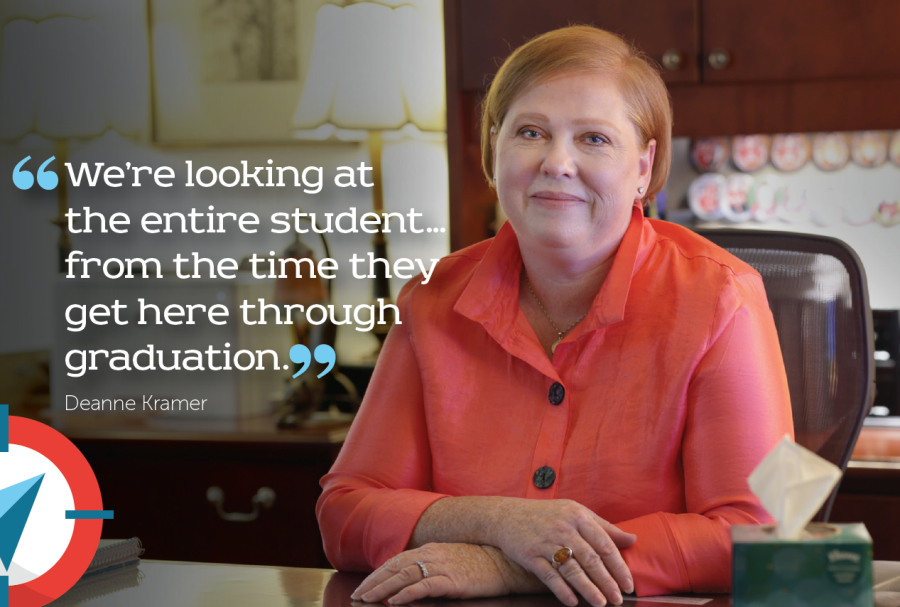
“We’re looking at the entire student,” Kramer said. “We’re not just looking at their major, and we’re not just focused on the next semester. We’re not just running down classes, entering classes for the next semester. We’re looking at students from the time they get here through graduation –– always focused on what we need to do to make sure they’re graduating on time. For me, that’s our ultimate goal.”
Growth and change
The CASA office was created within the College of Arts & Sciences in the summer of 2006, and its initial focus was advising sophomore students only. At that time, first-year students were advised in the home departments of their majors, or by Baylor University Advising (now called Major Exploration and Success Advising). Junior and seniors, meanwhile, were advised in their major departments.
That setup left a void for sophomores, which is why CASA was created within the College of Arts & Sciences. The initial staff consisted of three advisors who were housed in an old chemistry lab in the Marrs McLean Science Building.
CASA eventually moved into the basement of the newly renovated Sid Richardson Building with Dr. Sinda Vanderpool –– now the president of St. Mary’s University in Calgary, Canada –– as its director. When Vanderpool moved into the Baylor Provost’s Office in 2009, Kramer took over as CASA director. Previously, Kramer taught information systems in Baylor’s Hankamer School of Business, and was a city planner for the City of Waco prior to joining Baylor.
There was eventually another change made in location –– CASA is still in the Sid Richardson Building, but has moved to the second floor.
One of the biggest changes Kramer has witnessed during her 15 years in CASA is the introduction of the online tool known as Navigate, which houses the audit system and stores all academic notes for each student.
“Navigate really was the game changer, because now we can see everything about the student’s academics,” she said. “We can see the progress reports. We can see if they transferred from another academic unit over to us. We can see their background –– all of the advisors’ notes, and all of the faculty notes. It gives us a full picture of what that student has looked like since the time they stepped on campus until the time we are advising them.”
When the COVID-19 pandemic began necessitating major changes at Baylor in early 2020, one beneficial change involving CASA was forcing its advisors to go paperless. Previously, when CASA advisors met with students from the College of Arts & Sciences they would have to print out hard copies of an audit, which details a student’s academic progress.
The logistics of using the old paper-based system were daunting. CASA meets with more than 6,000 students twice each year, and each degree audit would require about four printed pages. Advisors needed to make two copies of each audit –– one for their files, and one to give to the student. All of that added up to CASA printing nearly 100,000 sheets of paper each year just to advise students.
“That’s a lot of paper –– a whole lot of paper. We’re happy to not have to do that anymore,” Kramer said. “Now, all of that is digitized, and it’s all emailed to students. They have full access to it electronically.”
*This story originally appeared in the Fall 2024 issue of Baylor Arts & Sciences magazine.
ABOUT THE COLLEGE OF ARTS & SCIENCES AT BAYLOR UNIVERSITY
The College of Arts & Sciences is Baylor University’s largest academic division, consisting of 25 academic departments in the sciences, humanities, fine arts and social sciences, as well as 11 academic centers and institutes. The more than 5,000 courses taught in the College span topics from art and theatre to religion, philosophy, sociology and the natural sciences. The College’s undergraduate Unified Core Curriculum, which routinely receives top grades in national assessments, emphasizes a liberal education characterized by critical thinking, communication, civic engagement and Christian commitment. Arts & Sciences faculty conduct research around the world, and research on the undergraduate and graduate level is prevalent throughout all disciplines. Visit the College of Arts & Sciences website.